
TNB RP4 Tariff Explained: Blocks, AFA and Solar Export Credits
Decision details
In this guide
Start with the bill month and kWh
The cited domestic reference distinguishes lower- and higher-usage account categories at 1,500 kWh. The RM0.4443/kWh and RM0.5443/kWh figures combine energy, capacity and network components and exclude AFA and other adjustments [source] [source] [source]. Do not treat them as sequential marginal blocks or a complete bill formula; confirm the account category and billing period.
| Reference item | Cited value and scope |
|---|---|
| Lower-usage account category | RM0.4443/kWh is the cited energy + capacity + network reference for the account category up to 1,500 kWh; excludes AFA and other bill adjustments. [source] [source] |
| Higher-usage account category | RM0.5443/kWh is the cited energy + capacity + network reference for the account category above 1,500 kWh; excludes AFA and other bill adjustments. These references do not establish a sequential whole-bill calculation. [source] [source] |
| AFA example | September 2026: +RM0.0367/kWh [source] when monthly usage exceeds the current-era gate — 800 kWh for bills dated 1 September–31 December 2026, reverting to 600 kWh from 1 January 2027 [source]; this is a dated example, not a rate for another bill month. |
| Retail charge | RM10/month when monthly usage exceeds the same era-qualified gate (800 kWh through December 2026; 600 kWh from January 2027), according to the cited threshold record [source]. |
Do not add the AFA to every unit or treat these entries as a single total rate without checking the billing calculation and the rule that applies to the account and month. The values above state the recorded components and conditions; they do not reconstruct a reader’s bill. [source] [source] [source] [source] [source]
The source also identifies the AFA and retail-charge gate, era-qualified: 800 kWh through 31 December 2026, then 600 kWh from 1 January 2027 [source]. AFA varies by month. The cited September 2026 amount is a dated example, not a forecast or a value to apply to another month [source] [source]. Check your own bill and the applicable notice before comparing periods.
Does a kampung home get a cheaper electricity tariff?
A kampung address alone does not identify a different tariff in the cited Peninsular TNB schedule. The applicable rate depends on the utility, account tariff class and bill period. The cited RP4 rates are for the Peninsular TNB schedule; for a bill from another area, use the utility and tariff class printed on that bill rather than applying these rates.
Check the utility name, tariff or account code, domestic use class, bill month and billed kWh. If you mean a rural-support discount rather than the ordinary tariff, ask the utility or relevant authority whether a specific programme currently covers your account and location. A rural electrification connection or a temporary past bill discount does not by itself establish a current lower per-kWh tariff.
Source: Energy Commission RP4 tariff page; tariff coverage in this guide is Peninsular TNB.
Keep solar self-use and export separate
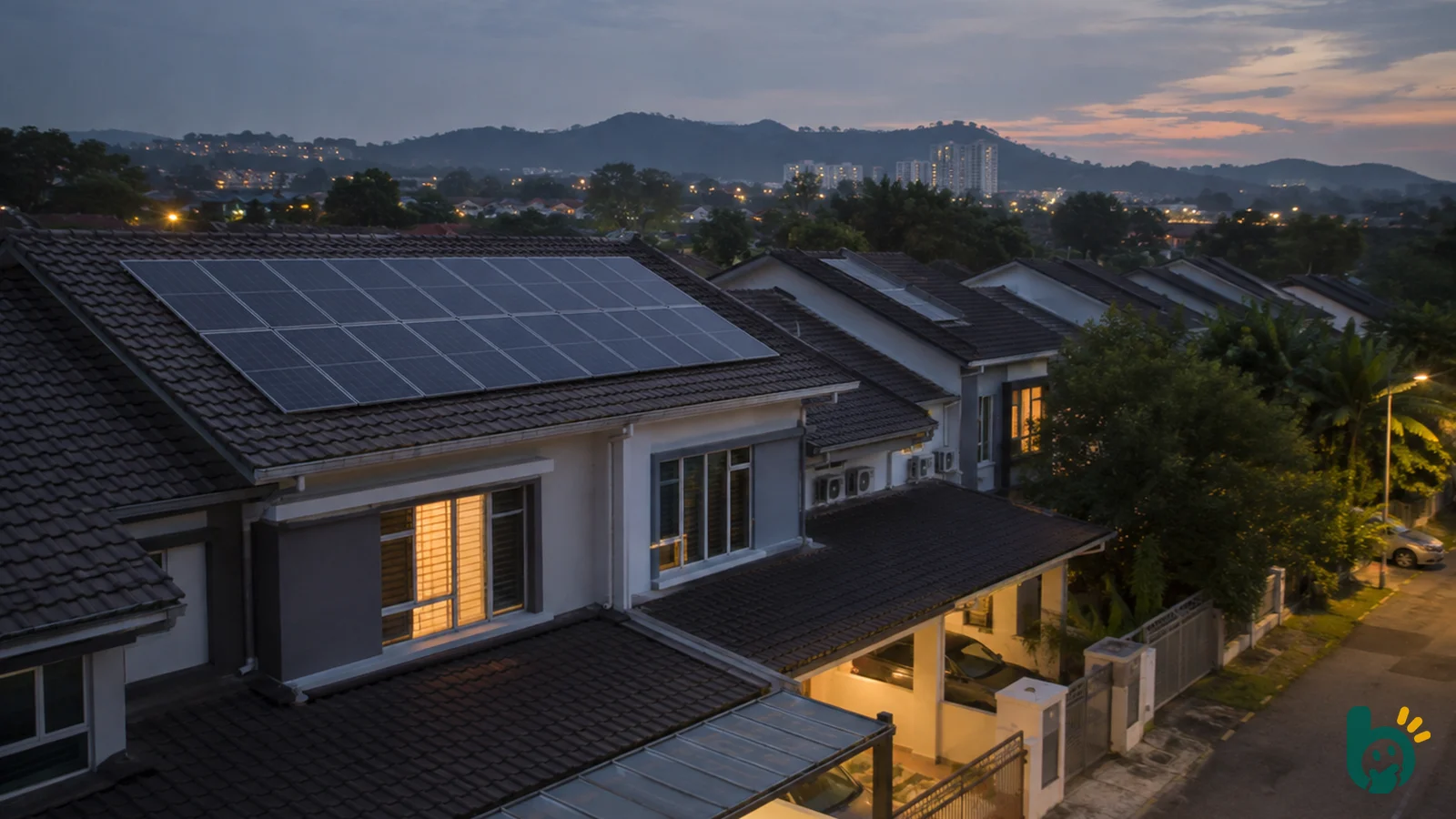
Solar generation consumed inside the home while it is being generated never appears on the bill as an import: import billing measures only energy drawn from the grid, and units absorbed simultaneously by the house’s loads never cross it [source] — in TNB’s published example, 394 kWh of self-used generation directly reduces imports to 406 kWh [source].
Electricity used while the system is generating can reduce the amount imported at that time. Electricity exported to the grid offsets the applicable energy-charge component within the same billing period; unused balance does not carry forward, and export credit cannot offset AFA [source]. The cited ATAP timeline is date-specific, so check the rules applicable to your installation and bill [source].
To compare two bills, record the bill month, kWh, billing days and any displayed AFA. For a solar offer, ask the provider to state generation, self-use and export assumptions separately in writing. Do not infer savings or a zero bill from panel capacity alone.
Has the AFA ever been negative?
Yes. The AFA is a signed adjustment, not a fixed surcharge: in TNB’s published monthly series, nine months carry negative values — verified verbatim examples include August 2025 at -RM0.0145/kWh, November 2025 at -RM0.0891/kWh and April 2026 at -RM0.0047/kWh; the series’ first month, July 2025, was 0.00 [source] [source]. A negative value means the adjustment reduces that billing month’s rate rather than adding to it — the same signed arithmetic by which +RM0.0367 lifted the low-block composite rate to RM0.4810/kWh in September 2026. As in surcharge months, the adjustment only enters the bill when usage passes the era-qualified gate (800 kWh for 1 September–31 December 2026; 600 kWh from 1 January 2027) [source].
The series’ most recently verified values: October 2026 +RM0.0361/kWh, November 2026 +RM0.0427/kWh, December 2026 +RM0.0446/kWh and the January 2027 forecast +RM0.0759/kWh [source]. Check your own bill month before using any of these figures; the AFA is announced monthly.
Read also: how to calculate an electricity bill, how to read a TNB bill and the solar hub.
Frequently asked questions
What is the cited TNB domestic rate per kWh?
The cited composite energy + capacity + network references are RM0.4443/kWh for the lower-usage account category and RM0.5443/kWh for the higher-usage category, separated at 1,500 kWh per month. They exclude AFA and other adjustments and are not sequential marginal blocks or a complete bill formula [source] [source] [source]. Confirm your account category and bill period.