
Solar Battery Suppliers in Malaysia: What to Verify Before Buying
Decision details
In this guide
Which type of solar battery supplier fits your job?
For a retrofit, put inverter compatibility first. For a new installation, compare the complete system. For backup, put the loads you need to keep running first. This gives you a useful shortlist even before you choose a battery size.
| Your job | Start with this kind of proposal | What decides the comparison |
|---|---|---|
| Add a battery to existing solar | A supplier who identifies your exact inverter and proposes a documented battery match | Keep the existing inverter or replace it; include any controller, wiring and commissioning costs |
| Buy solar and storage together | A complete PV, inverter and battery proposal with one clear commissioning scope | Total installed cost, usable capacity, equipment pairing and who handles service across components |
| Keep essential loads running in an outage | A proposal naming the backed-up circuits and the equipment needed to supply them | Supported power and usable energy, backup switching and the appliances included in the design |
Tell each supplier which of these jobs you want priced. If you want both evening energy use and outage backup, state both: they are separate design questions. A low unit price can lose its advantage when the quote requires an inverter replacement or additional backup work. Use the dated seller examples below to start a price conversation, then compare the complete proposals for your job.
Compare the complete system, not the battery unit price
A seller displayed installed Sungrow SBR 5 kWh at RM7,999 and 10 kWh at RM14,999 [source] [source]. These dated seller listings are reference points, not a multi-seller market survey or a quote for your home. Ask for the exact model and separate lines for battery, inverter or hybrid inverter, controls, electrical work, installation, commissioning and warranty.
| Item | Ask the seller to state | Why |
|---|---|---|
| Capacity | Nominal and usable kWh, discharge limits and supported loads | Usable energy is not the same as nameplate capacity |
| Compatibility | Exact inverter, battery and control models; any export-control setting | Do not assume mixed components work together [source] |
| Warranty | Term, covered parts, claimant, labour and exclusions | A headline warranty does not state the claim process |
| Property insurance vs product warranty | Ask the insurer whether the policy or endorsement lists the PV modules, inverter, battery and related roof/property damage. Request written confirmation for the events you want checked, such as theft, fire or wind; record exclusions, excess, claim steps and who handles the claim. Request product-warranty scope separately. | A product warranty does not establish that a property policy covers system or roof damage. |
| Installation | Outdoor rating, placement plan, fire-safety scope and total installed price | Safety and location affect actual installation scope [source] |
To compare two offers fairly, send each provider the same site details: whether this is a new PV installation or an addition to an existing system, the exact existing inverter model if there is one, the loads you hope to cover and the proposed battery location. Ask for one written scope with the battery and inverter models, usable capacity, installation and commissioning, total delivered price, warranty claimant and exclusions, plus any extra electrical or fire-safety work. Compare matching scopes; an empty line is still unanswered, not a zero-cost item.
Dated seller price references
| Battery model | Capacity | Dated seller figure | Configuration stated in source | Evidence |
|---|---|---|---|---|
| Sungrow SBR | 5 kWh | RM7,999 installed | Separate Sungrow SG hybrid inverter (DC) | [source] |
| Sungrow SBR | 10 kWh | RM14,999 installed | Separate Sungrow SG hybrid inverter (DC) | [source] |
| Sungrow SBR | 15 kWh | RM21,999 installed | Separate Sungrow SG hybrid inverter (DC) | [source] |
| Huawei LUNA S1 | 5 kWh | RM9,999 installed | Separate Huawei SUN2000 hybrid inverter (DC) | [source] |
| Huawei LUNA S1 | 10 kWh | RM17,999 installed | Separate Huawei SUN2000 hybrid inverter (DC) | [source] |
| Tesla Powerwall 3 | 13.5 kWh | RM35,000–45,000 installed (stated average RM40,000) | Built-in inverter (AC) | [source] |
A low-cost deep-cycle listing is a different class
A nominal 12 V, 100 Ah unit represents 1.2 kWh before discharge-depth limits, conversion losses and operating conditions. At 50% depth of discharge, the simple nominal usable-energy arithmetic is about 0.6 kWh before those additional losses. That is not equivalent to an integrated home LFP battery. Compare total system cost and usable energy, not a standalone battery sticker price.
Buy the components yourself or request an installed proposal?
Buying components yourself can suit a DIY project or a buyer who intends to select and manage each item separately. For a home battery, compare that route with an installed proposal that states who handles installation, commissioning and warranty. If you bring your own battery to an installer, confirm in writing whether they will install and commission it, what work is excluded and who handles post-installation issues. Compare totals only on the same scope: an online component price is not the full installed-system cost.
Check placement and programme boundaries
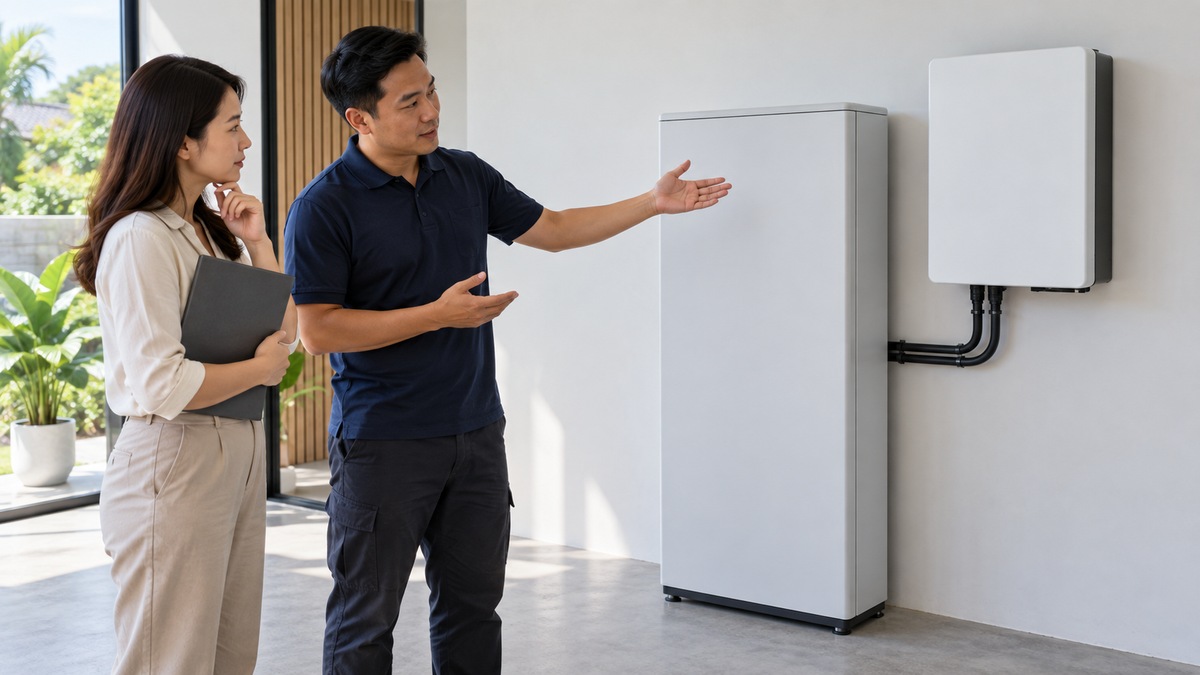
The cited BESS safety guidance recommends outdoor installation; outdoor equipment needs IP54 or higher. Where indoor placement cannot be avoided, suitable fire suppression and Bomba compliance are required [source]. Ask the provider to state the proposed location, protection rating, compliance work and who bears any additional cost.
Solar ATAP began on 1 January 2026 and has a recorded ten-year contract term [source] [source]. The cited export rule credits eligible domestic exports against the energy component within the same bill month; this alone does not prove a battery’s payback [source] [source]. Ask the installer to state the system’s export configuration and who handles the application.
Before paying, get the battery model, usable kWh, inverter match, itemized price, installation location, safety scope, warranty and service contact in writing. This guide does not identify a “best supplier.”
Read next: battery package costs · home battery guide · solar hub
Frequently asked questions
How should I choose a solar battery supplier in Malaysia?
Match the supplier's proposed scope to your job: an existing-inverter battery addition, a complete new system, or backup for named circuits. Compare the exact equipment, installed total and service responsibility. A battery price alone does not answer compatibility or outage support.
How much is a home solar battery in Malaysia?
One installer displayed installed Sungrow SBR 5 kWh at RM7,999 and 10 kWh at RM14,999. These are one seller's product listings, not a market range [source] [source].
Can I use a cheap 12 V deep-cycle battery instead?
It is a different product class. A nominal 12 V × 100 Ah is 1.2 kWh before usable-depth, conversion and operating limits; it is not equivalent to a home LFP system.