
Solar Inverters and Battery Readiness: Checks Before You Choose
Decision details
Fits if: Owners comparing string, micro or hybrid proposals who want to understand battery connection options.
Main drawback: Compatibility, price, warranty and performance depend on the exact model and contract; this page establishes no brand support or price.
Compare: shade and layout, inverter model, battery path, kWac, manufacturer/installer warranty, written scope and price.
In this guide
Start with requirements, not labels
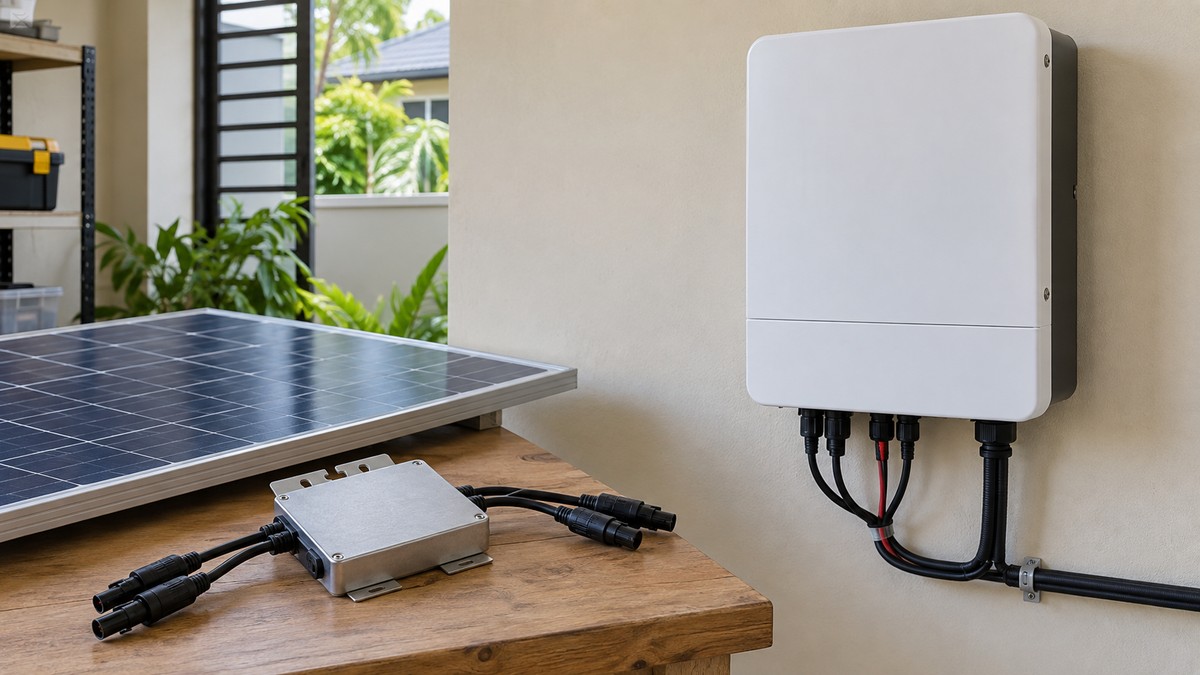
String, micro and hybrid systems cannot be compared with one universal rule. Ask each provider to state exact models, panel layout, expected shade, monitoring, service, replacement parts and warranty responsibility. Check that each design assumption appears in the proposal.
If a battery may be needed, request the connection route and supported models in writing. “Battery-ready” does not identify a battery model, configuration, controls or warranty conditions. If written evidence does not cover the exact proposed models, mark compatibility unverified.
Compare equivalent scopes
If the home already has a grid connection and the main goal is reducing electricity purchases, ask for a PV-only price first as the baseline. Do not pay extra just for a “battery-ready” label or a battery capacity that has not been matched to actual use. Storage is more relevant when you want named circuits supplied during an outage, or when an exact-model proposal shows value from using surplus later after system and replacement costs. For backup, name the circuits/appliances and required duration; for energy shifting, bring import/export records and load timing. In either case, compare the full installed total, not the battery line alone.
Request quotes for systems serving the same objective: one without a battery and one with a specified battery route. Compare inverter, battery, installation, protection, electrical work, monitoring, exclusions, maintenance, total price and each party’s warranty. Do not treat one advertisement as a market price or a universal add-on cost.
For domestic Solar ATAP, inverter connection capacity is expressed in kWac; panel kWp is a different measure [source]. Ask the provider to explain the figure used in the application and identify who is responsible for submission [source].
Questions for the provider
- What exact inverter and battery models are in the offer?
- Has the manufacturer confirmed this model combination and configuration in writing?
- What operates during a grid outage, and which circuits are actually backed up?
- Who is responsible for design, application, installation, service and each warranty?
- What is the total price, exclusions, scope-change process and offer expiry?
Do not decide from verbal claims about compatibility, savings or payback. Put assumptions, exclusions and responsibilities in the same written proposal.
For outage backup, name the appliances that must stay on and ask for a diagram showing which circuits receive power and how the system switches to backup mode. Compare that requirement with the stated output for the exact inverter and battery models; a proposal mentioning “backup” does not establish that the whole home is backed up.
Frequently asked questions
What is the difference between string, micro and hybrid inverters?
They are different system-design choices with different equipment boundaries and functions. Compare exact model data sheets, inputs, shade design, monitoring, installation and service terms; the class name alone does not determine results.
Does a hybrid inverter guarantee that I can add a battery later?
No. Request the exact supported battery models, software versions, approved configuration and warranty terms in writing from the manufacturer or supplier. Without written confirmation, treat compatibility as unverified.
Can a battery be added to an existing system?
Possibly, depending on inverter, wiring, controls, space, protection and applicable approvals. Request a site assessment and two written options—an appropriate AC route with existing equipment or replacement—without assuming either is compatible.