
Buying Vegetable Seeds Online: The Shopee and Seed-Shop Reality
Decision details
Fits if: New home growers starting to buy vegetable seeds online and confused between RM2 e-commerce packs, nearby seed shops and agricultural suppliers.
Main drawback: The card numbers on this page are dated display prices with platform sales records; not verified transactions, and this page sells nothing and endorses no seller.
Compare: named class/variety; seed count or weight; germination rate; expiry date; channel-scale match; seller record; delivery zone.
Share your vegetable buying needs
In this guide
Summary: buying vegetable seeds online in Malaysia is a genuinely large cheap-pack economy — multi-class cards record tens to hundreds of thousands of units sold on e-commerce — running alongside physical seed shops and agricultural suppliers. No official daily seed price exists; label discipline and scale-matching decide the right purchase.
What is “buying vegetable seeds online” in Malaysia, actually?
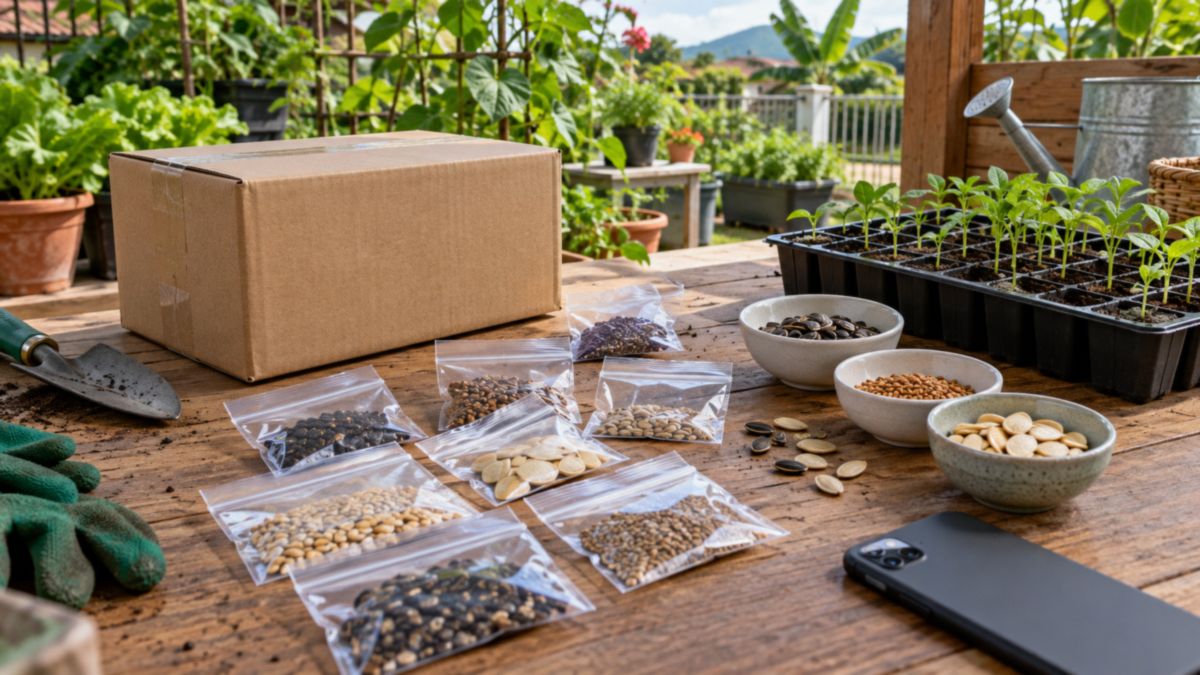
It is a standing and very alive e-commerce class. Real user searches on 2/10/2026 displayed these forms: “benih sayuran lengkap” (complete), “benih sayuran shopee”, “benih sayuran terdekat” (nearest), “benih sayuran hidroponik”. On the seller side, multi-class cards hold the highest sales records in our entire vegetable-demand evidence — hundreds of thousands of units for one multi-class card at a cheap pack price (evidence slot). The fresh class, on the other hand, is nearly absent from e-commerce: fresh-vegetable searches render seed cards or nothing. In short: Malaysia’s vegetable e-commerce is basically a seed shop.
How much do vegetable seed packs cost?
Honest level: there is no official daily seed price — FAMA’s daily list watches fresh produce like kangkung and sawi and carries no seed row for any crop. [source] What exists are dated seller displays: a cheap layer for popular local classes (two-ringgit-range packs in the 1/10/2026 reading, cabbage and broccoli cards under four ringgit), a middle layer for numbered brands, and a coded imported F1 layer at a very different level. These are display signals, not transactions we verify.
How do you choose between Shopee, a physical seed shop and an agricultural supplier?
Match the channel to your scale and risk. E-commerce: small packs, popular classes, checkable seller records — cheapest per trial. Physical seed and agricultural shops: labels read before paying, zone-appropriate advice — safest for new classes. Agricultural suppliers: kilograms and F1 codes with dated quotes — best value for farms. These three channels sell different scales; comparing an e-commerce pack price against a supplier’s kilo price is the wrong comparison from the start.
What are the “multi-class” cards with hundreds of thousands of sales?
Cards selling several seed classes in one purchase — the buyer chooses the classes. The highest sales record in our evidence comes from this form (evidence slot), and the reason is functional: home growers want several types in one cheap transaction. The weaknesses: contents are not always named individually, per-class germination rates are not stated, and variety is not guaranteed. Fine for trying; not for a garden that depends on it.
How do you read a seed label correctly?
Four mandatory lines: variety name or code; seed count or gram weight; germination rate (the percentage of seeds expected to sprout); expiry date. A label without all four is selling a thing, not seeds. For hybrid classes add the F1 status — F1 seed does not breed true, so it is a recurring cost every season; open cultivars can become your own supply.
When is buying online the wrong choice?
Three situations: kilogram quantities (supplier prices are almost always better with official labels); high-value F1 classes (fake-card risk — buy from official distributors); and purchases tied to tight planting dates (late delivery delays the whole sowing schedule). For all three, physical channels or suppliers give control e-commerce does not.
How do you avoid non-germinating seeds after buying?
Test first, commit later: sample-sow from every new lot before sowing a full bed. Store leftover seeds in a dry container labelled with the date; respect the expiry date; and buy in that class’s season — a cool-season class sown in hot weather fails not because the seller cheated. Record sowing dates and germination results; that is your evidence when claiming replacements.
What must you check before paying an online seller?
The card’s content list (not just the box photo); the named variety; seed count or weight; germination rate and expiry on the actual label; seller record and ratings; the return policy for non-germinating seeds; and delivery zone and expected timing. Traceable payment leaves room for claims — follow the safe-payment guide in our commerce section.
We do not sell seeds and do not verify any seller’s prices. Use the WhatsApp below to organise your checking questions; final price and stock must be confirmed directly with the seller.
Read also: vegetable-growing capital costs · wholesale vegetables near me, online · how to pay safely when buying online
Frequently asked questions
Can I buy vegetable seeds online in Malaysia?
Yes, and the class is large: multi-class seed cards on e-commerce record tens of thousands to hundreds of thousands of units sold as of the 1/10/2026 reading, and real searches include 'benih sayuran shopee' and 'benih sayuran terdekat' (banked 2/10/2026). Physical seed shops and agricultural suppliers remain the channels for full labels and kilo quantities.
How much do vegetable seeds cost?
There is no official daily seed price — FAMA's daily list watches fresh produce only and carries no seed row. [source] Pack prices move by class, weight and channel; the cheap e-commerce layer and the imported F1 layer sit at very different levels.
Which is better — Shopee or a physical seed shop?
By need: e-commerce is strong on small packs of popular classes with high sales records; physical seed shops let you read the label, germination rate and expiry before paying; agricultural suppliers are for kilograms and specific F1 codes. The channels are not direct price competitors — they sell different scales.
What are those very popular 'multi-class' packs?
'Various vegetable seed choice' cards sell one card with several classes inside — the highest sales records in our evidence come from this form. Good for trying things; the weakness is the contents are not always named one by one — check the content list before paying.
How do I avoid seeds that do not germinate?
Three checks: the germination rate printed on the label; an expiry date still open; and buying in that class's planting season. Germination-test each new lot with a sample sowing before committing big, and store leftover seeds in a dated dry container.
Is there a list of seed shops near me?
Real user searches take the form 'kedai benih sayur near me' and 'benih sayuran terdekat' (banked 2/10/2026) — that demand is served by maps and local shops, not a national list. We keep no premise list; ask for channel guidance by your zone via the WhatsApp below.
Share your vegetable buying needs
Betulkex is testing demand for vegetable supply. Share what you need to start a discussion with Betulkex; stock, prices and delivery areas are unconfirmed.
View dated retail references
Dated KPDN PriceCatcher retail reference; not our selling price, wholesale price, market average, stock confirmation or delivery promise.
| Vegetable | Unit | Premise | Date | Retail reference | Source |
|---|---|---|---|---|---|
| Okra | 1 kg | MY HERO HYPERMARKET PRESINT 3 | MYR 6.76 | KPDN PriceCatcher | |
| Okra | 1 kg | PASAR TANI, PRESINT 4 | MYR 11.00 | KPDN PriceCatcher | |
| Red chilli (Kulai) | 1 kg | MY HERO HYPERMARKET PRESINT 3 | MYR 11.99 | KPDN PriceCatcher | |
| Red chilli (Kulai) | 1 kg | PASAR TANI, PRESINT 4 | MYR 15.00 | KPDN PriceCatcher | |
| Cucumber | 1 kg | MY HERO HYPERMARKET PRESINT 3 | MYR 3.99 | KPDN PriceCatcher | |
| Cucumber | 1 kg | PASAR TANI, PRESINT 4 | MYR 4.50 | KPDN PriceCatcher | |
| Tomato | 1 kg | MY HERO HYPERMARKET PRESINT 3 | MYR 5.29 | KPDN PriceCatcher | |
| Tomato | 1 kg | PASAR TANI, PRESINT 4 | MYR 8.50 | KPDN PriceCatcher | |
| Long bean | 1 kg | MY HERO HYPERMARKET PRESINT 3 | MYR 11.16 | KPDN PriceCatcher | |
| Long bean | 1 kg | PASAR TANI, PRESINT 4 | MYR 12.00 | KPDN PriceCatcher |