
Your First Variegated Monstera: The Buyer Checklist (Root Photos, Nodes, Rot Tests — Ask Before You Pay)
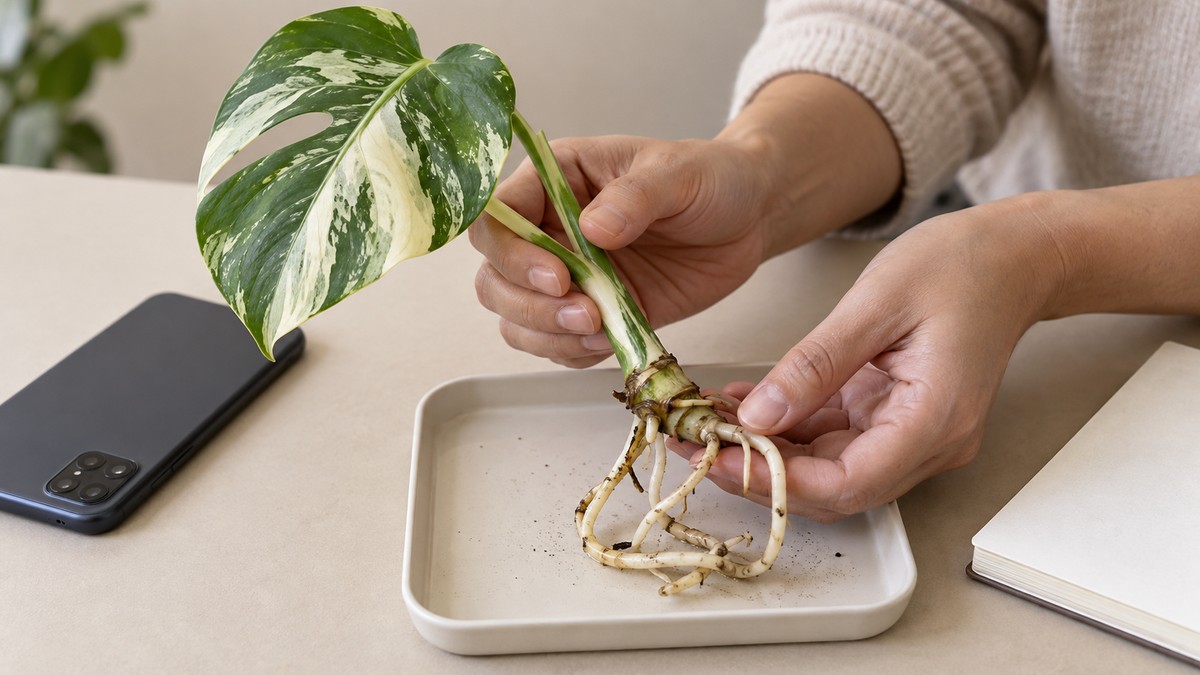
In this guide
A green monstera forgives. A variegated one — bought as a cutting, from a stranger, through a chat window — does not. The gap between the two is not the price; it is what the buyer knows to ask before paying. This page is that checklist, built from the trade conventions running through the mined buyer threads: node checks, root photos, rot tests, medium of arrival, and the seller reputations that travel inside plant groups.
The checklist, in asking order
| # | Ask / check | Why the trade does it |
|---|---|---|
| 1 | Node photo (close-up) | No node = no plant, whatever the leaf looks like |
| 2 | Root photo or rooting-medium photo | Roots in the photo beat adjectives in the caption |
| 3 | Squish test on the cut end (in person) | Firm = fine; soft/sinking = rot |
| 4 | Newest leaf, unfurled, in natural light | Variegation visible without seller lighting tricks |
| 5 | Arrival medium (sphagnum? stratum? water?) | Sets your first-week care plan |
| 6 | Seller history in the group | Blacklist threads exist because scams repeat |
The node — the one non-negotiable
The single most reassuring sentence given to a nervous first buyer, verbatim from the trade thread: “Variegated monsteras can be white, cream colored, and even yellow! In the first picture, it looks like an albo while the second pic has more thai constellation looking markings but im no expert. As long as the plant has a node for you to grow it, you have not been scammed; if it does turn out to be a thai constellation, good for you! That means the variegation is stable and you wont have to worry” (agvx-mw-mon-0123, reddit r/Monstera, Jul 11 2020).
Read what it actually says: even the expert was not sure what cultivar it was — and it did not matter, because a node grows whatever it is. The buyer’s relief followed the same logic: “Okay, I feel much better. And yeah, I can already feel a bump off the node where it will have new growth.” (agvx-mw-mon-0124, reddit r/Monstera, Jul 11 2020). Node first, pattern second, price third.
Roots and media — the arrival plan
Rooted-in-what matters more than rooted-or-not. The medium tells you what to do on day one:
- Fluval stratum / sphagnum: rooting media. Wash off what you can and pot into your own mix once roots are substantial — “It’s aquatic soil which a lot of people use for rooting and it works great” (agvx-mw-mon-0108, reddit r/Monstera, Sep 18 2026).
- Moss, if you keep it a while: damp, never wet — “just spray the moss with water to keep it damp. Don’t get the moss too wet”, and expect detangling pain later (agvx-mw-mon-0122, reddit r/Monstera).
- Water-rooted: easiest to inspect, hardest to ship. Check the water is clean at pickup.
The community’s default for expensive arrivals is a repot-as-inspection: “Try not to overthink it, monsteras are tough and the leaf looks fine. I always repot my new plants so I can a) check roots and b) use a decent soil mix. Handle it like you would a cheap monstera and just wait for it to grow 👍” (agvx-mw-mon-0103, reddit r/Monstera, Dec 11 2021). That last clause is the philosophy of the whole trade: the care that works on a RM20 monstera is the same care that protects a RM400 one. [source]
Rot: the squish test, the tilt, the sulfur
Cuttings die at the cut end. The tests, in order:
- Squish test: firm end is healthy; soft, sinking, smelly is rot. “If the end is not squishy, it’s not rot.” (agvx-mw-mon-0122)
- If rot: trim back to firm tissue with a clean blade, let the cut air-dry, “keep the end dry and exposed to air. Plant at a tilt.” (agvx-mw-mon-0121)
- Sulfur dip if available: “Also dip the end in sulfur if you’ve got it or can get it.” (agvx-mw-mon-0121) — cinnamon is the kitchen-shelf substitute the trade passes around; treat both as tradition-grade precautions, not medicine.
- And the blunt eye of a second look: “No— I see brown at the base. It’s not healthy.” (agvx-mw-mon-0120, reddit r/Monstera, Mar 8 2026) — brown at the base overrules a pretty leaf every time.
Seller reputations travel
The plant-trade convention with no shopfront: Facebook groups keep threads of sellers to avoid, and buyers read them before paying strangers: “I agree with the fb groups! They have a thread of sellers to NOT buy from to prevent this sort of thing. Plus all US based so no long waiting times.” (agvx-mw-mon-0128, reddit r/rareplants, Aug 14 2020). In Malaysia the same job is done by group admins and comment history: a seller with visible delivery photos in old posts is a different risk class from a brand-new profile with three pictures. That, plus the ruler rule — measure, don’t trust the photo — is the whole trust layer; the full blacklist-and-ruler playbook is on the online-buying defence page.
After you pay: one week of calm
New plant, quarantine spot away from your collection, bright-but-not-direct light, water only when the top layer dries, no fertilizer yet. A droop week is transport shock, not verdict. The pot-size page covers the repot decision; the price sanity page covers what you should have paid — both written for the Malaysian market side of this trade.
Every quote above is attributable community voice (rid + platform + date). Tests described are trade conventions passed buyer-to-buyer, not laboratory protocols; no disease-treatment claims.
Frequently asked questions
What should I ask the seller for before buying an albo cutting?
Three photos minimum: the node close-up (growth point or a visible bump), the roots (or the rooting medium it sits in), and the newest leaf unfurled — plus, if shipped in sphagnum, how long it has been wrapped. Experienced buyers repot new arrivals partly to inspect roots: 'I always repot my new plants so I can a) check roots and b) use a decent soil mix.'
How do I check a cutting for rot before buying?
The squish test first: 'If the end is not squishy, it's not rot' (agvx-mw-mon-0122). Soft, sinking tissue at the cut end is rot; firm is fine. If you already own it: trim to firm tissue, keep the end dry and in air, plant at a tilt, and dip the end in sulfur if you can get it (agvx-mw-mon-0121).
My albo arrived rooted in sphagnum moss — what now?
Wash the stratum or moss off as clean as you can and move it into your growing medium — sphagnum is a rooting medium, not a forever home: 'If there are good amount of roots, simply wash the stratum off as clean as you can and put into the growing medium of your choice' (agvx-mw-mon-0108). If you root in moss yourself, keep it damp, never wet — spraying beats soaking.
What is a node and why does the seller's listing need one?
The node is the growth engine — the bump on the stem from which new leaves and roots come. A leaf without a node is a pressed flower, not a plant. The trade's own reassurance to a scared first buyer: 'As long as the plant has a node for you to grow it, you have not been scammed' (agvx-mw-mon-0123).
It was listed as a half moon on Facebook but looks small and different in person — was I scammed?
Pattern names get stretched by sellers: 'it was listed on Facebook as a half moon, so I just assumed it was one... when I saw it in person, I was surprised by how small it was' (agvx-mw-mon-0109). Ask for the node photo and a current video before paying; assume listing labels are optimism until the plant proves otherwise.