
Why mosquitoes spin after electric shock
Affiliate links: we may earn a commission. Disclosure
Decision details
In this guide
Why are mosquitoes attracted to certain people?
The biting females find hosts by signal: carbon dioxide in the breath, body heat, and skin odours set by sweat and skin microbes. People who breathe harder while working, run warmer, or sweat more simply broadcast louder — “sweet blood” has nothing to do with it. This signal-chasing also explains the device hierarchy: CO2 traps catch females because they copy the breath signal, while UV lamps, which offer a light cue females do not follow for blood, mostly catch other insects.
Why do mosquitoes fly near your ear and make that sound?
The whine is wingbeat — the female’s wings beat fast enough to sing. She circles your head because your breath plume is concentrated there; the ear happens to sit inside the approach path. It is tracking, not taunting: close the plume (screens, a fan moving the air over the bed) and the circling stops.
Why do mosquitoes feed on blood?
Only the female bites, and only to make eggs: blood supplies proteins no nectar can. Both sexes live on plant sugars the rest of the time — the males never bite at all. That single biology is why she is precise, patient and hard to discourage mid-hunt, and why protection is built on barriers and repellents rather than on out-guessing her.
Killing mosquitoes with an electric racket — what to know
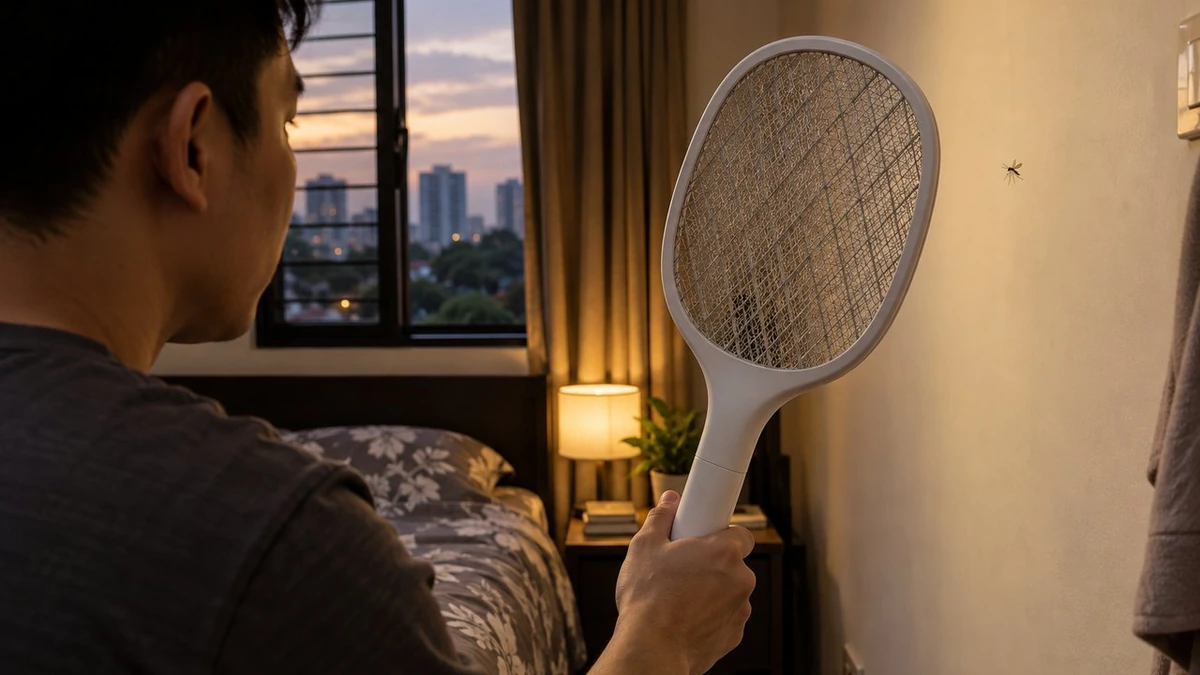
- The racket kills by contact; the spin-and-drop you see is motor disruption, and a stunned mosquito can recover. Press the swing home or finish it.
- Aim where they rest and where they commit to a landing — wild swings in open air mostly tire your wrist.
- The racket is the honest end of one mosquito. It does nothing about the water that produced it; the container outside is still manufacturing tomorrow’s whine.
- Avoid the gimmick class entirely: ultrasonic repellers have failed controlled evaluations, and a spinning mosquito on a racket is more evidence than those devices ever produced.
Why do mosquitoes exist in the world at all?
Larvae feed fish and aquatic predators; adults feed birds, bats and dragonflies; males pollinate on their sugar runs. The family is old and entangled with ecosystems — which is why the practical mission is not “all mosquitoes” but the few container-breeding, day-biting species that carry dengue around Malaysian homes. Their population is the one your water walk, screens and racket actually touch.
Baca juga: hub nyamuk · mosquito-killer-review · where-to-buy-electric-mosquito-killer
Frequently asked questions
Is a mosquito still alive after it spins from an electric racket?
Often yes, briefly. The shock scrambles the nerve signals driving the wing muscles, and the uncoordinated firing looks like spinning. Give the racket a second contact or finish with a swat if the intention is a clean kill.
Why do mosquitoes fly near my ears at night?
They are tracking the carbon dioxide and warmth around your head, and your ear is part of that plume. They are not attracted to the sound itself — the whine you hear is the female's wingbeat as she circles the signal.