
Agricultural Commodity & Produce Prices in Malaysia: Durian, Rice, Palm Oil & Greens
Decision details
Fits if: Commercial growers, fresh produce traders, orchardists, and agricultural buyers in Malaysia.
Main drawback: Do not assume fixed peak season prices for premium durians; seasonal production gluts trigger steep market corrections requiring active floor-price monitoring.
Compare: Crop seasonality vs regulated ceiling prices, MPOB oil extraction rate (OER) regional formulas, and official wholesale market guides.
In this guide
What is the market price and supply trend for Black Thorn and premium durians?
Premium Malaysian durians, including Black Thorn (D200) and Musang King (D197), command strong market interest across Peninsular Malaysia:
- Harvest Season Gluts: During major seasonal harvest surges, lower-grade durians can experience sharp price drops, as seen when lower-grade Musang King adjusted from roughly RM90 down to RM9–10 per kg, leading FAMA to step in with floor-price buying operations [source].
- Urban Retail Hubs (Johor Bahru & Klang Valley): Retail prices in consumer hubs like Johor Bahru include sorting, transportation, and premium stall overheads, creating a notable spread over farm-gate orchard pricing.
- Orchard Nutrition: Applying balanced NPK fertilizers according to Department of Agriculture 4R principles—right source, right rate, right time, right place—maintains tree vigor and pulp quality [source].
How are daily FFB palm oil prices tracked on MPOB servers?
Growers and investors searching for live daily fresh fruit bunch (FFB price today Malaysia server) rates should understand the regulatory data architecture:
- Server-Side Data Architecture: MPOB BEPI web endpoints do not host a direct daily FFB public table series; rather, the pricing plane relies on monthly 1% OER regional infographics and daily CPO spot prices [source].
- Regional 1% OER Reference: In August 2026, MPOB established mill-gate reference values per 1% OER at RM49.33 for Northern Region, RM49.99 for Southern Region, and RM50.07 for Central Region [source].
What are the typical market prices for leafy greens and baby kailan?
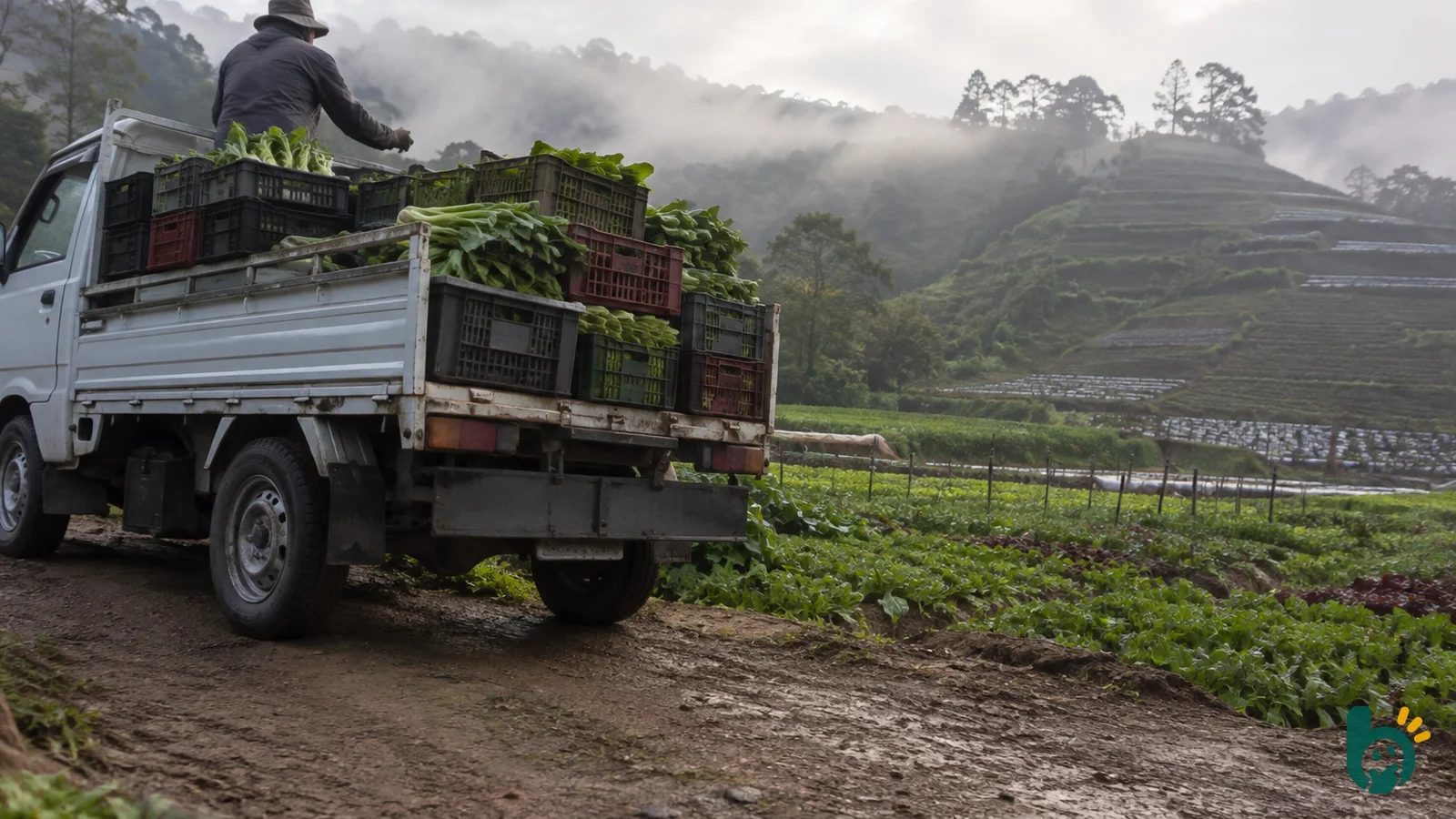
Fresh market produce pricing (gambar sayuran di pasar and harga baby kailan) varies daily according to wholesale market arrivals:
- FAMA Market Guide: The Federal Agricultural Marketing Authority (FAMA) publishes daily average indicative price guides for wholesale and wet markets across Malaysia, recording items such as highland green mustard (sawi) at RM5.39 per kg and yardlong beans at RM7.18 per kg [source].
- Premium Leafy Greens: Specialty greens like baby kailan command a higher price bracket due to tender leaf specifications and shorter shelf-life handling requirements.
| Commodity / Product Category | Pricing Mechanism / Standard | Benchmark Rate / Official Range | Source & Reference Era |
|---|---|---|---|
| Local White Rice (Beras Tempatan) | Statutory maximum retail ceiling price | RM2.60 per kg [source] | KPKM Regulation 2025 |
| National Padi Floor Purchase Price | Minimum guaranteed mill purchase rate | RM1,500 per metric tonne [source] | Cabinet / KPKM 2025 |
| Fresh Fruit Bunches (FFB Central Region) | Monthly MPOB reference per 1% OER [source] | RM50.07 per 1% OER [source] | MPOB August 2026 |
| Highland Green Mustard (Sawi Hijau) | FAMA national daily wholesale guide | RM5.39 per kg [source] | FAMA 27 September 2026 |
| Yardlong Beans (Kacang Panjang) | FAMA national daily wholesale guide | RM7.18 per kg [source] | FAMA 27 September 2026 |
| Chilli Fertigation Nutrient Input | Stock A & B fertilizer sets (100 bags) [source] | RM440 per season (2 sets) [source] | DOA Malaysia 2023 Guide |
What is the price and agricultural use of rice husk ash (abu sekam padi)?
Rice husk ash (abu sekam padi) is a widely utilized agricultural byproduct in Malaysian commercial nurseries and soil conditioning:
- Soil Aeration & Drainage: Ash and carbonized rice husk provide lightweight structure, preventing soil compaction in potted plants and polybags.
- Microbial & Soil Enzyme Boost: Scientific studies demonstrate that organic soil amendments stimulate vital soil enzyme activities—including protease, urease, and cellulase—improving organic nutrient cycling for crop root uptake [source].
Why is local white rice (beras putih tempatan) capped at per kg?
The pricing of local rice in Malaysia is governed by statutory food security regulations: [source]
- Retail Price Ceiling: Local white rice (beras putih tempatan) is subject to a statutory price ceiling of RM2.60 per kg to ensure affordable staple food access for all Malaysian households [source].
- Farm-Gate Floor Support: Concurrently, the government adjusted the minimum guaranteed padi floor price from RM1,300 to RM1,500 per metric tonne to safeguard paddy farmers against rising production costs [source].
What drives dried chilli (cili kering) market pricing per kg?
Dried chilli (cili kering) pricing in Malaysia is influenced by import supplies and domestic commercial chilli fertigation costs:
- Import Dependence: A substantial share of whole dried chillies is imported, with prices shifting according to freight rates and regional foreign currency exchanges.
- Local Fertigation Alternatives: Local commercial growers utilize precision fertigation, where nutrient fertilizer costs average RM440 per 100 polybags per season to achieve premium fresh yield quality [source].
Baca juga: panduan kos pertanian · jadual baja fertigasi sayur
Durian black thorn harga
What factors determine Black Thorn (D200) durian pricing in Malaysia?
Black Thorn durian pricing operates on a multi-tier structure based on fruit aesthetics, pulp recovery rate, and sales channel. Grade A fruit commands a substantial premium because it meets the strict cosmetic and weight requirements demanded by export packing houses and premium urban retail outlets.
The key determinants of Black Thorn value include:
- Fruit Shape & Symmetry: A well-rounded fruit with five full lobes ensures maximum pulp yield per kilogram of total husk weight.
- Skin Integrity: Zero insect boring marks, skin cracks, or fungal stains on the rind.
- Pulp Dry Matter & Colour: Deep salmon-orange to golden hues with wrinkled skin indicate optimal physiological maturity and rich flavour.
- Harvest Timing: Early-season and late-season harvests achieve higher spot prices than fruit harvested during peak mid-season surges.
How do seasonal market shifts and input costs impact Black Thorn profitability?
While Black Thorn is positioned as a luxury durian cultivar, it is not immune to broad market swings. During intense national harvest gluts, price drops affect varieties across the board [source]. When lower grades flood the market, buyers enforce stringent grading criteria, heavily discounting deformed or undersized Grade B and C fruit.
At the same time, growers must manage escalating production expenses, as agricultural fertilizer prices have experienced significant upward pressure [source]. Official price tracking portals like the Federal Agricultural Marketing Authority (FAMA) daily market guide illustrate wholesale market pricing patterns across commodities [source], highlighting the importance of benchmarking farm production costs against real market trends.
| Grade Tier | Physical & Quality Specifications | Market Channel & Pricing Realization |
|---|---|---|
| Grade A | Round shape (4-5 full lobes), 1.8–3.5 kg, clean husk, no borer damage | Top-tier pricing; export blast-frozen or premium fresh retail |
| Grade B | Slightly irregular shape (3 full lobes), 1.2–1.8 kg or >3.8 kg, minor blemishes | Moderate discount; local retail stalls and domestic consumption |
| Grade C / Reject | Deformed (1-2 lobes), severe pest holes, damaged rind, or burnt tips | Steep discount; channeled to downstream paste processing and puree |
What is the economic timeline and break-even for Black Thorn cultivation?
Establishing a commercial Black Thorn orchard requires long-term planning and capital discipline:
- Years 1–4 (Vegetative Gestation): Focus on tree structure, deep rooting, vegetative flushing, and wind protection. Operating costs consist primarily of irrigation, weed management, and soil organic conditioning.
- Years 5–6 (Initial Flowering & Fruiting): First commercial fruit harvest. Initial yields are modest (10–20 fruit per tree) and fruit thinning is critical to avoid vegetative stress.
- Years 7–10 (Commercial Maturity & Payback): Yields ramp up to 50–80+ fruit per mature tree annually. At steady Grade A production, commercial orchards typically reach cumulative operational break-even within this window.
How can growers optimize net returns from Black Thorn orchards?
Maximizing profit per hectare requires producing a high percentage of export-grade fruit rather than chasing unmanageable fruit numbers. Implementing disciplined fruit thinning ensures that each retained fruitlet develops adequate carpel symmetry and pulp thickness.
Furthermore, orchardists should diversify sales channels by establishing direct relationships with cold-chain consolidators and reputable wholesale off-takers. By monitoring market trends and managing input costs systematically, growers can safeguard farm margins through changing harvest seasons.
Frequently asked questions
What causes Black Thorn and Musang King durian prices to fluctuate significantly?
Seasonal bumper harvests can lead to sharp market gluts where farm-gate prices adjust downward, prompting FAMA intervention and minimum floor price measures.
What is the official retail price cap for Malaysian local white rice?
Local white rice (beras putih tempatan) is price-controlled by the government at a maximum ceiling price of RM2.60 per kg [source].
Can farmers access live daily fresh fruit bunch (FFB) prices on MPOB servers?
MPOB servers do not publish a standalone daily FFB price series; instead, mill-gate FFB prices are derived from regional monthly 1% OER reference prices [source] and daily CPO rates.
How does rice husk ash benefit agricultural soil?
Rice husk ash provides organic silica, improves soil porosity, and enhances soil enzyme activity when integrated as a natural soil amendment.
Why is Black Thorn (D200) durian priced higher than most other cultivars in Malaysia?
Black Thorn features a distinct deep orange-red flesh, smooth custard texture, and a complex sweet-alcoholic taste profile, supported by high export demand and relatively limited mature tree acreage.
What distinguishes Grade A Black Thorn from lower grades at the farm gate?
Grade A Black Thorn must be rounded with 4-5 well-developed carpels (lobes), weigh between 1.8 kg to 3.5 kg, and have an intact stem with zero borer holes or fungal blemishes.
How long does a Black Thorn durian orchard take to break even?
A well-managed Black Thorn orchard typically begins commercial bearing around year 5-6, reaching operational break-even between years 8 to 10 depending on initial capital expenditure and yield.