
Skeletal Quartz Benefits (骨干水晶功效): What Tradition Says, Colour Variants, Which Hand
In this guide
骨干水晶功效 — the benefits question for the skeletal/elestial class — is one of those queries where the searcher already loves the stone and wants the lore confirmed and organised. So this page leads with the lore, attributed, generously — then does what we always do: separates what the mineral is (verifiable) from what the traditions say it does (belief, held with respect), and connects the follow-on questions the same search space asks: colour variants, which hand, five elements, daily use. The specimen itself — our one museum-grade piece — has its own buyer’s page.
What the traditions say it does
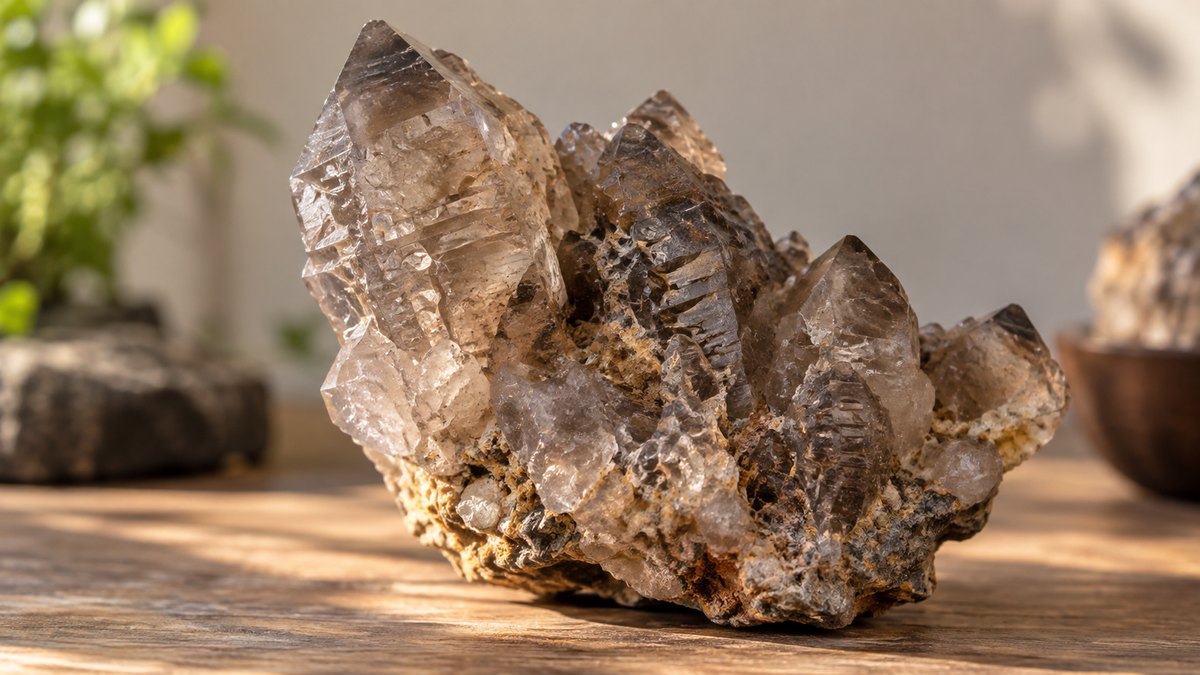
Two frames, one stone. The Western New Age frame calls skeletal quartz the old-soul piece: holding ancient recorded information, releasing energy slowly and patiently, a companion for deep meditation. The Chinese frame — the one most Malaysian collectors inherit — centres settling: 骨干 as bones of the mountain, grounded, composed, holding old stories. The local market’s own language for the red-mud variant is the fullest expression of it, from a mined Malaysian seller’s post: “对应海底轮,红泥的铁质与天然骸骨的沉稳能量结合” — corresponding to the root chakra, the red mud’s iron combined with natural skeletal quartz’s settled energy, settling a restless field downward into safety and solidity. We pass all of it on as tradition — real, warm, and the reason this class has devotees. What we can state as fact is the structure: etched stepped growth, layered windows, Mohs 7 — a crystal that recorded its own violent formation history in its skin. The two layers sit together nicely; neither needs to pretend to be the other.
The colour variants, decoded
The trade has a full colour vocabulary — 黑骨干 (black), 金骨干 (gold), 紅骨干 (red), 黑金骨干 (black-gold), 菠蘿骨干 (pineapple, knobbed), 三輪骨干 (three-wheel) — and tradition assigns each its nuance: black for protective settling, gold with the wealth frame, red-mud for the strongest grounding story through the iron coating. Colour-lore, attributed. Mineralogically they are one thing: skeletal quartz, with iron content and coating making the palette. Choose the look that draws you; the attributed meaning follows the colour you chose, which is how this tradition has always worked.
Which hand, which element
The mined queries pair 功效 with 左右手, so: the receiving-left / releasing-right convention from our which-hand page is the frame; settling-grounding stones sit left in it. But notice — this class is mostly a display and sitting-with stone, not a wearing stone (the bracelet versions exist but are not our lane; we are the raw-stone house). For raw pieces the equivalent question is placement: low, stable, where the keeper actually sits. Five-element reading follows the colour convention: clear-to-white metal, red-mud fire-earth, black water.
Daily use, honestly
The class rewards patience. A mined collector’s routine is the whole practise in one line: “我是睡覺就放在骨幹水晶 一天12小時” — hers rest on the skeletal quartz twelve hours a day. Another long-time player ranks the class among her great loves: “以前超愛茶晶跟黃水晶尤其是骨幹駭骨系列的” — especially the skeletal series. And the live-market scene treats it as event stock — a mined seller’s post: “纯天然「骸骨骨干水晶」摆件今晚登场” — natural skeletal specimen debuting tonight. Museum-tier, one piece at a time, that is exactly how we hold it too. Care: quartz-safe methods (moonlight, smoke, sound); skip long salt soaks on etched surfaces — cleansing hub for the full set.
Ask about the skeletal quartz on WhatsApp
Disclosure: BePositive.my is our shop; the skeletal specimen is listed RM588–788 as of 2026-09-30 (first-party capture, 1 piece in stock) — re-verify at the live listing. Traditional associations quoted as tradition; we make no efficacy claims. [source]
Read next: Skeletal quartz buyer’s page · Which hand to wear · Zodiac and five elements · Cleansing hub · Crystal hub
Frequently asked questions
What is skeletal quartz believed to do?
In New Age tradition: old-soul energy — ancient recorded information, slow patient release, deep meditation. In Chinese collector tradition: grounding and settling — the bones-of-the-mountain frame, paired with the root chakra and composure. Attributed tradition on both sides; the mineral facts (etched layered growth, Mohs 7) are checkable and separate.
Do the colour variants differ in meaning?
Trade names differ by look — black skeletal (黑骨干), gold skeletal (金骨干), red-mud skeletal (红泥骨干, iron-rich coating), pineapple skeletal (菠萝骨干, knobbed) — and tradition assigns them nuance: red-mud for grounding through the iron-and-root frame, black for protective settling, gold for the wealth-frame warmth. These are colour-lore conventions, attributed; the underlying mineral and structure are the same etched quartz.
Which hand do you wear skeletal (骨干) on?
The mined query space asks 骨幹水晶功效左右手 together. The general convention (receiving left, releasing right) is the frame most sellers use; grounded settling stones sit toward the left in that frame. For raw display pieces — which is how this class is actually kept — the question becomes placement instead: low, stable, near the keeper. Both answers passed on as tradition.
What element (五行) is skeletal quartz?
By the colour convention: clear-to-white skeletal reads metal/gold; red-mud skeletal reads fire-plus-earth through its iron coating; black skeletal reads water. Same caveat as all element mapping — conventions differ by school; treat the column as a shopping lens, not chemistry.
How do you use a skeletal piece daily?
The honest answer is slowly — the class rewards sitting-with. One mined collector's routine: her pieces rest on the skeletal quartz twelve hours a day while she sleeps. Cleansing and charging follow the quartz-safe standards: moonlight, smoke, sound; avoid long salt soaks on etched surfaces.