
What Is Labradorite? Flash, Moonstone Confusion, Opalite, and Checks Before You Buy
In this guide
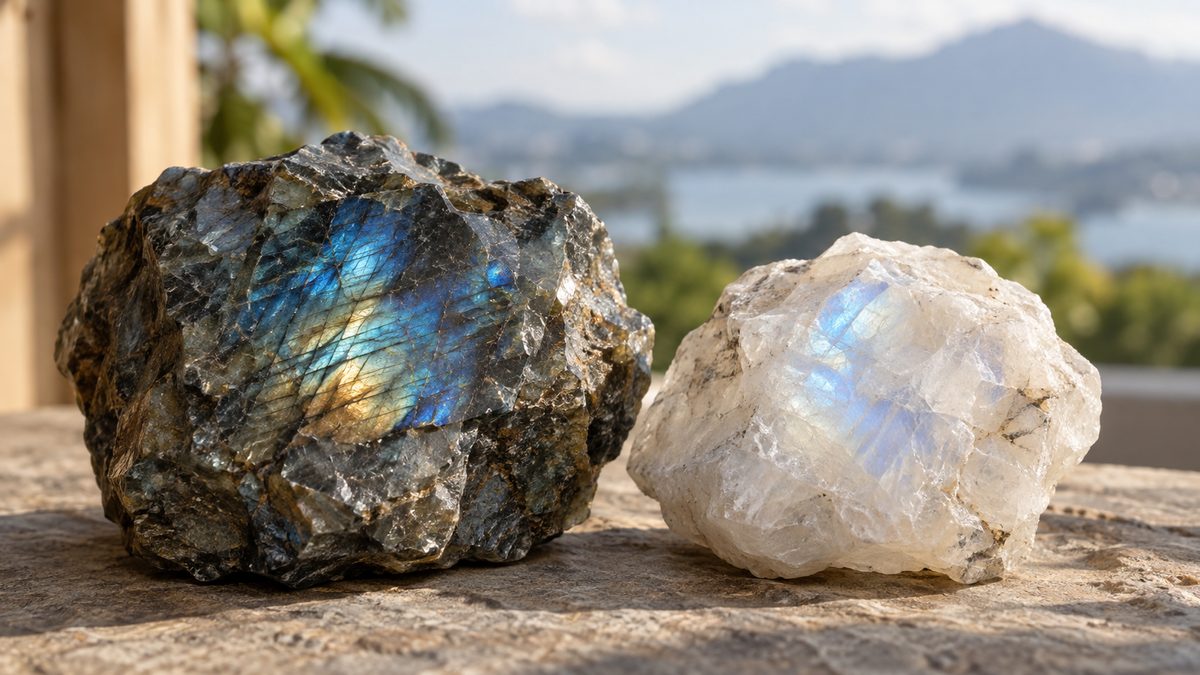
Labradorite is known for labradorescence: colour that appears to shift as the stone and light move. It is not moonstone, even though trade names such as 灰月光 can blur the distinction. When comparing listings, first identify what stone is being offered and what evidence applies to the exact piece; a listing name or flash in a photo does not confirm mineral composition.
What labradorite actually is
Labradorite is a plagioclase feldspar. Its colour flash changes with the light angle, but seeing a flash—even in video—is not a mineral or treatment test. Ask what material the seller is naming and whether any lab report states the scope of its examination; do not treat a general certificate or the word “natural” as proof that a particular piece was tested.
The moonstone confusion, sorted
Three stones get sold in one lane, and the mined questions show the confusion is real — 拉长石是月光石吗, 拉长石和灰月光一样吗, 拉长石和月光石区别:
- Moonstone (月光石) — orthoclase feldspar. Its glow is soft and moonlit, rolling like a cloud across a milky body (adularescence). Blue-sheen white moonstone is the classic.
- Labradorite (拉长石) — plagioclase feldspar. Hard, flashy colour sheets on a dark body. When grey and low-flash, Malaysian Chinese sellers often call it 灰月光, grey moonlight — a trade naming convention, worth knowing so you pay labradorite prices for labradorite, not inflated “moonstone” prices.
- Rainbow moonstone — actually a white labradorite variety. Yes, really. The trade’s fault, not yours.
Rule of thumb: soft rolling glow = moonstone; hard moving flash = labradorite. Body dark = labradorite family; body milky-white = moonstone family.
The fake to refuse: opalite
The most common moonstone “fake” is not treated stone at all — it is opalite, man-made glass, milky blue-violet, glowing evenly under any light. It looks magical in a dark room and flat in daylight. Tells: uniform glow that does not follow the light angle; no layered structure; on beads, faint mould seams. There is nothing wrong with opalite as cheap decor glass — the problem is only when it is sold as moonstone at moonstone prices. Ask the seller directly: is this opalite glass? Honest sellers answer honestly.
What tradition says (attributed)
In crystal tradition, labradorite is the stone of magic and protection — believed to shield the aura during change; moonstone is the stone of the feminine and new beginnings, tied to lunar cycles. In the Chinese five-elements register some sellers assign both to water/metal classes — 月光石五行 queries in our data — quoted as tradition, not doctrine. Sleeping with stones, wearing sides (left or right), and taboos (禁忌) all belong to that belief layer; we cover the wearing-side convention on its own page with attribution.
Care, briefly
Both are feldspars at Mohs 6-6.5 — softer than quartz. Avoid knocks (cleavage planes make them chip-prone), avoid ultrasonic cleaners, and cleanse gently: moonlight, smoke, sound are all safe; skip long salt-water soaks.
Our band
Our 30 Sep 2026 first-party Seller Centre capture records an overall listing band of RM49-59 and two seller option labels, “130-170gm” and “100-130gm.” Those labels are not measured weights, no price is mapped to either option, and this dated record does not show today’s price or stock. Ask for the price of the exact option and the delivered total before comparing. [source] [source]
Compare offers on the same basis: ask for several-angle photos and a rotating video of the exact piece to be sent, the seller’s written material description, measured dimensions and weight, the price for that exact option, and the delivered total. Keep the answers in writing and check that the photo, measurements and price all refer to one item. Video helps you assess appearance and flash; it cannot verify mineral identity or treatment. A seller’s weight option label is not a scale reading.
Ask for labradorite videos on WhatsApp
Disclosure: BePositive.my is our shop. The 2026-09-30 capture is a record of our own listing, not a market price or current stock. Confirm the exact item and current total with the seller.
Read next: How to tell real crystal from glass · Which hand to wear · Cleansing guide · Crystal hub
Frequently asked questions
What is labradorite?
A plagioclase feldspar (Mohs 6-6.5) famous for labradorescence — sheets of internal colour (blue, gold, green) that flash and vanish as the stone moves under light. Fine-grade material with a full-spectrum flash is traded as spectrolite, from Finland; most market material is from Madagascar.
Is labradorite the same as moonstone?
Different minerals in the same feldspar family. Moonstone (orthoclase feldspar) shows a soft, moonlit glow that rolls across the stone — adularescence. Labradorite shows hard flashes of colour. In Malaysian Chinese shops, grey labradorite is often sold as 灰月光 (grey moonlight), which is a naming convention to know, not a mineral fact.
How do you spot a fake moonstone?
The big one is opalite — man-made glass sold as moonstone. It looks milky-blue and glows evenly under any light, often too uniformly. Real moonstone has layered structure, blue sheen that follows the light angle, and natural inclusions; opalite has none of the layering and often visible mould seams in bead form.
Is labradorite safe to wear?
Physically yes — it is a normal feldspar, Mohs 6-6.5. One mined question asks exactly this. Belief-side, tradition treats it as a protective stone; that is attributed lore, not our claim.
What do labradorite and moonstone cost in Malaysia?
Our Seller Centre capture from 2026-09-30 records an overall listing band of RM49-59. This is not a market price or a price for each option; check the live listing and delivered total for the exact piece. [source]