
Crystal Care (保养): Scratches, Fading, Storage, the Cracked Piece — How to Actually Keep Crystals
In this guide
Buying the crystal is the easy part. Keeping it beautiful for years is a craft, and the Malaysian question space knows it — 水晶怎么保养, how to keep, how to store, why the bracelet went rough, what to do when something cracks. This page is the care hub: the physical craft (scratches, fading, storage, cleaning) and, given its proper room, the tradition’s side — because in collector culture, 保养 care and 养 nurturing are one practice, and the belief layer is not something we strip out. What we keep separate is what’s verifiable: hardness, sunlight, storage. Those carry the authority here; the lore rides warmly alongside.
The two layers of care
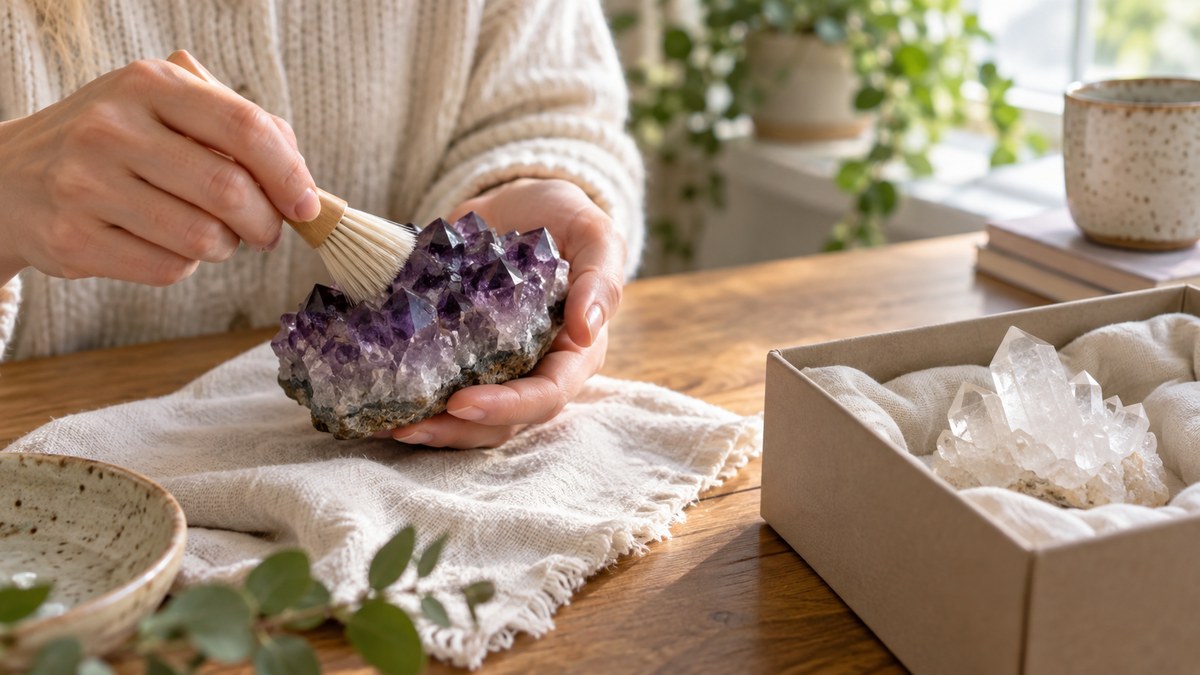
Physical care is simple physics: quartz family stones (clear, smoky, citrine, amethyst, rose — Mohs 7) scratch everything softer than themselves — malachite (3.5–4), calcite (3), fluorite (4). Store them apart. Coloured quartz fades in prolonged harsh sun — a mined caution puts it exactly: “也能用日曬的方式但是淺色系的水晶就不適合日曬法了” — sun works as a method, but pale-coloured stones are not suited to it. Dust and skin oil clean off with a soft brush and plain water on tolerant stones. And some methods of “care” are physically risky — “有些水晶不可以用鹽。淨化音樂也可以。” (some crystals cannot take salt; cleansing music works too) — the salt warning is physics, the sound method is the tradition’s gentle default. Both true on their own levels.
Traditional care (怎么养) is the nurturing frame: the stone is kept, cleansed, charged, spoken to — a relationship, not a possession. We pass that on as tradition, warmly, because it is genuinely how this community loves its stones. Our cleansing hub and charging hub carry the practice side in full.
The bracelet that went rough
The single most-relatable care question we mined: “我的水晶手鏈變得粗糙,我該怎麼處理呢?” — my crystal bracelet has become rough, what do I do? The physical answers: beads rub beads and round edges chip microscopically; soaps, sanitisers and dust grind into the surface; soft stones roughen months before quartz does. Fixes: restring (fresh cord, proper knots), a gentle wash where the stone tolerates water, and taking it off for sleep, showers and heavy work. The traditional answer — the piece has absorbed a lot and deserves a thorough cleanse and rest — is the community’s own frame, and it coexists with the physical one. We sell no bracelets; we say this as the raw-stone shop that hears the question weekly.
Storage: the cluster-bed habit
The storage convention the community loves most doubles as the cleansing station: stones rest on a cluster or chip bed, so shelf and 消磁 station are one piece of furniture. One mined collector’s rhythm is the purest version: “我每天回家都吧手鏈放回晶族上😂” — home, bracelet back on the cluster, every day. Beyond that: holder stands for points, acrylic boxes for small treasures, padded boxes for travel, LED bases for the show pieces. And hardness separation, always — the museum-grade cluster that costs four digits should never share a drawer with tumble-grade pebbles.
Cracks: the question people ask quietly
Two mined voices, both honest. First: “為何我的水晶,放一些能量進去後,都會從內部裂開” — why does my crystal crack from the inside after I put energy in? The physical answer: it almost always didn’t. Veils and fissures are growth features that catch light differently over time; real new internal cracks come from thermal shock or knocks. A long-time collector’s taste confirms the positive side: “我最喜歡裡面有冰裂紋或是雲霧的” — the ice cracks and mist inside are exactly what she loves most. Second: “如果水晶摔破,祂們會希望我們如何安置呢?” — if a crystal breaks, how would they want to be settled? Tradition’s gentle answers: return to earth or sea, keep as a protective ‘sacrifice’, gift the fragments. Our practical line: a clean break can be displayed honestly as a specimen; a shattered piece is a storage lesson. Either way, the etiquette is real and we respect it — the disposition matters to the keeper.
Caring for the classes we stock
Quartz clusters, points and beds (Mohs 7) are the hardy class — water-safe, sun-cautious for the coloured ones. Softer holdings — calcite, malachite, fluorite — want dry, padded, shaded shelves. Crystal trees (the wire-and-chip kind) want dusting, not washing, and a gentle hand on the branches. And everything displayed wants, eventually, its traditional maintenance — the cleanse-and-charge cycle — on whatever schedule you actually keep.
Ask about stands and storage on WhatsApp
Disclosure: BePositive.my is our shop; stand and storage stock dated 2026-09-30 (RM9.90–62 at capture), first-party, re-verify at the live listing. [source]
Read next: The cleansing hub · The charging hub · Feng shui placement · Budget guide · Crystal hub
Frequently asked questions
How do I take care of crystals day to day?
Physically: keep them from scratching each other (quartz at Mohs 7 scratches everything softer), keep coloured quartz out of harsh direct sun, dust and oil cleaned gently with a soft brush and plain water where the stone tolerates it. Traditionally: cleansing and charging on a schedule you keep — that side is belief, passed on as tradition; the scratch and fade side is physics.
Why did my crystal bracelet become rough?
A mined question asks exactly this. Physical answers first: bead-to-bead rubbing polishes and chips edges, skin products and dust grind into the surface, and soft stones roughen fastest. The fix is restringing, occasional gentle wash (stone permitting) and not sleeping or showering in it. The traditional answer — the piece has 'worked hard' and needs cleansing — we pass on as the tradition's frame, alongside the physical one.
Can scratches or internal cracks in a crystal be fixed?
Surface scuffs on quartz can be re-polished by a lapidary, but it removes material and character. Internal cracks cannot be fixed — and most 'new cracks' were always there: veils and fissures are natural inclusions, and a mined collector's taste runs exactly to them. Temperature shock (hot sun to cold water) is the real way new internal cracks happen; avoid it.
How should I store crystals?
Separated by hardness — soft stones (malachite, calcite, selenite) away from quartz; the collector-favourite arrangement is a cluster or chip bed that doubles as the traditional cleansing station. One mined collector's nightly habit: the bracelet goes back on the cluster every evening. Stands, acrylic boxes and padded boxes do the rest.
What do I do with a crystal that broke?
Tradition has gentle answers — return it to earth or sea, keep it as a 'sacrificed' protective piece, or gift the fragments — and one mined collector asks her teacher the honest version: what would the stone itself want? Our practical line: a clean break on a specimen can be professionally displayed as is; a shattered shelf piece is a lesson in storage, not an omen.