
Salt Crystal Cleansing (海盐消磁): The Strongest Tradition, the Real Damage List, Every Bowl Question Answered
In this guide
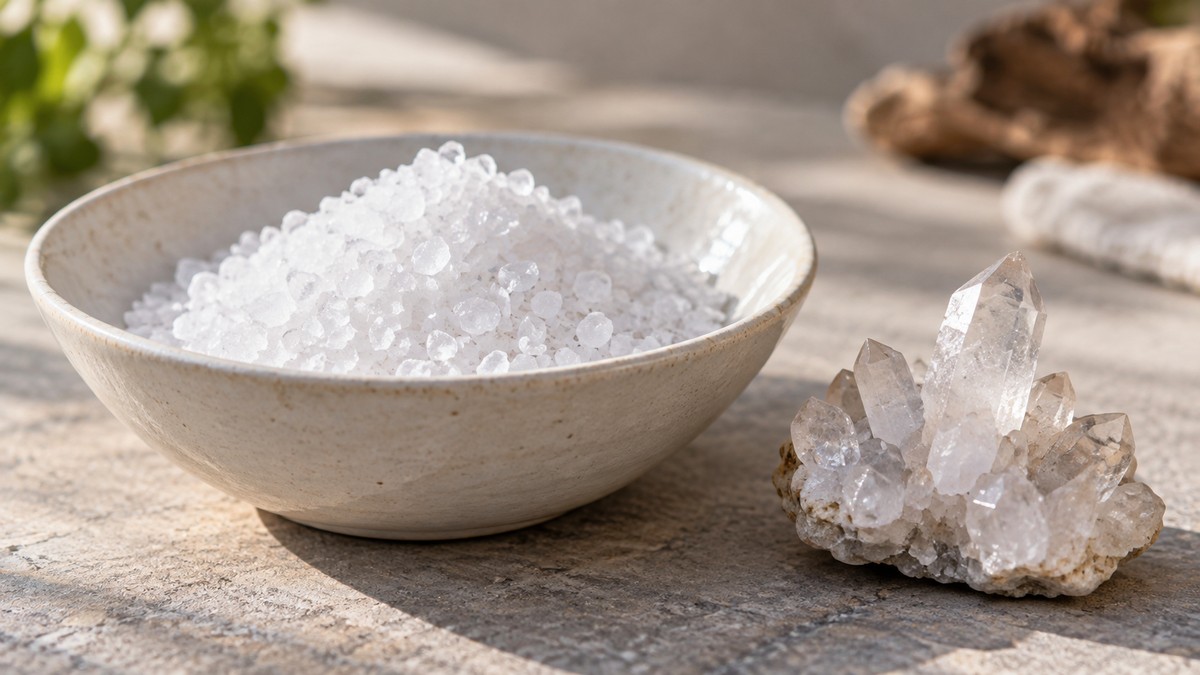
Salt is the strongest cleanse in the Chinese collector tradition — 海盐/粗盐, the coarse sea salt method — and it is also the one place where belief and mineralogy genuinely collide. This page gives the tradition its full weight, then gives the damage list equal weight, because salt is the only common cleansing method that can permanently ruin a stone. Read both halves before you pour.
The tradition, generously
In Chinese collector usage, coarse salt is the classic deep 消磁: the stone beds in dry salt overnight, or soaks in salt water for a stronger version; the belief is that salt absorbs and neutralises what the stone has taken on. Even the counter-argument is tradition — one mined shop-owner dismisses the whole apparatus: “放在窗外一個晚上 接收日月照射就能消磁了” — just put it by the window overnight for sun and moon, no salt nonsense needed. Both camps are belief; you choose your school. What neither camp can argue with is the next section.
The damage list (physical, not negotiable)
Never salt-water soak: selenite/gypsum (it is the same mineral family as salt’s chemistry targets — it can roughen and dissolve), calcite and most carbonates, malachite and copper-family minerals, pyrite and sulfides (they tarnish and decompose), hematite, angelite, amber, opal, anything glued, dyed or resin-filled.
Dry-salt bed: hard quartz fine, everything above still cautious. Clear quartz, amethyst, citrine, smoky quartz — the quartz family at Mohs 7 handles dry salt without complaint. For softer or metallic stones, even dry contact is unnecessary risk when cluster, smoke and sound exist. A mined comment states the tradition’s own safety rule: “有些水晶不可以用鹽。淨化音樂也可以。” — some crystals cannot use salt; sound cleansing works too.
Every bowl question, answered
These come straight from the mined comments — they are everyone’s questions:
- How full do I fill the bowl? A mined question: “是要放滿滿的海鹽在碗公上嗎” — fill it deep enough to bed or bury the stone, a few centimetres; the salt is the medium, not a garnish.
- Do I flip the stone halfway? One collector cleansing an obsidian piece on salt asks “要消磁進化 要翻面嗎” — whether to turn it over. The tradition has no fixed doctrine — overnight-on-each-side is a tidy compromise. There is no physics here; there is consistency.
- Reuse the salt? A mined question — “碗公內的粗鹽可以留下來下次使用嗎?” — Replace it when it clumps or after heavy use — the tradition reads used salt as loaded, and humidity decides anyway.
- One bowl, several stones? Fine within the hard-quartz family; separate when hardness differs or anything metallic/porous joins.
- Damp climate? A collector near the harbour asked whether slightly moist salt still works — “我家靠近碼頭,濕氣重” — for the ritual yes, for polished surfaces damp salt is more aggressive; dry it in shade or move to the cluster method in humid weather.
Our position, plainly
We are a raw-specimen shop, and salt is a method you run at home with grocery-store coarse salt — we do not need to sell you anything for it, and we say so. Where salt is wrong for your stone, the tools that are right (clusters, chip beds) are the classes we stock. That is the honest division: method pages that sometimes conclude “buy nothing”.
Disclosure: BePositive.my is our shop. This page concludes “buy nothing” for the salt itself; where we point to tools it is because your stone class cannot take salt. Cluster and chip-bed stock dated 2026-09-30 at the live listing.
Read next: Cleansing hub · Cluster and chip beds · Water cleansing · Crystal hub
Frequently asked questions
How do you cleanse crystals with salt?
Two forms. Dry salt: bury or bed the stone in coarse sea salt in a bowl, overnight to a day — the traditional 消磁 salt method. Salt water: soak in saline — stronger in tradition, far riskier physically. If your stone is on the damage list below, use neither; cluster, smoke or sound instead.
Which crystals cannot be cleansed with salt?
Physically: selenite and gypsum (salt and water can dissolve or roughen them), calcite family, malachite and most copper minerals, pyrite and sulfide minerals, hematite, angelite, amber, opal, and any polished soft stone. A mined comment says it plainly: 有些水晶不可以用鹽 — some crystals cannot use salt. Quartz family (clear, amethyst, citrine, smoky) tolerates dry salt fine.
Can I reuse the coarse salt?
One mined question asks whether the salt in the bowl can be kept for next time or must be replaced each cleanse. The tradition's logic — salt as the absorbing medium — says the used portion has 'taken' what was cleared, so replace it periodically; practically, salt is cheap and clumps with humidity. Replace when it clumps or after heavy use.
Can different crystals share one salt bowl?
A mined question asks this directly — 「可以把不同水晶放在同一個碗嗎?」 The physical answer: yes for hard quartz-family stones; no when hardness differs a lot (a hard stone scratching a soft one) or when anything metallic or porous is involved. The tradition's answer: separate bowls keep each stone's clearing its own — follow whichever layer you trust, but the damage logic is the physical one.
My salt went damp — is it still usable?
One harbour-side collector asked exactly this — 「我家靠近碼頭,濕氣重」 — humidity kept their coarse salt slightly moist. Damp salt is fine for the ritual but worse for the stones: moist salt is more chemically aggressive on polished surfaces. Dry the salt in shade first, or switch the damp climate over to a cluster method.