
Why Papaya Leaves Turn Yellow and Flowers Fail to Set Fruit
Decision details
Fits if: Papaya growers investigating yellow leaves, flowers that fall, or trees that flower without setting fruit.
Main drawback: A leaf colour or a single flower cannot confirm a nutrient deficiency, pest, virus or root disease by itself.
Compare: Age and pattern of affected leaves, underside signs, soil moisture and drainage, and flower structure.
In this guide
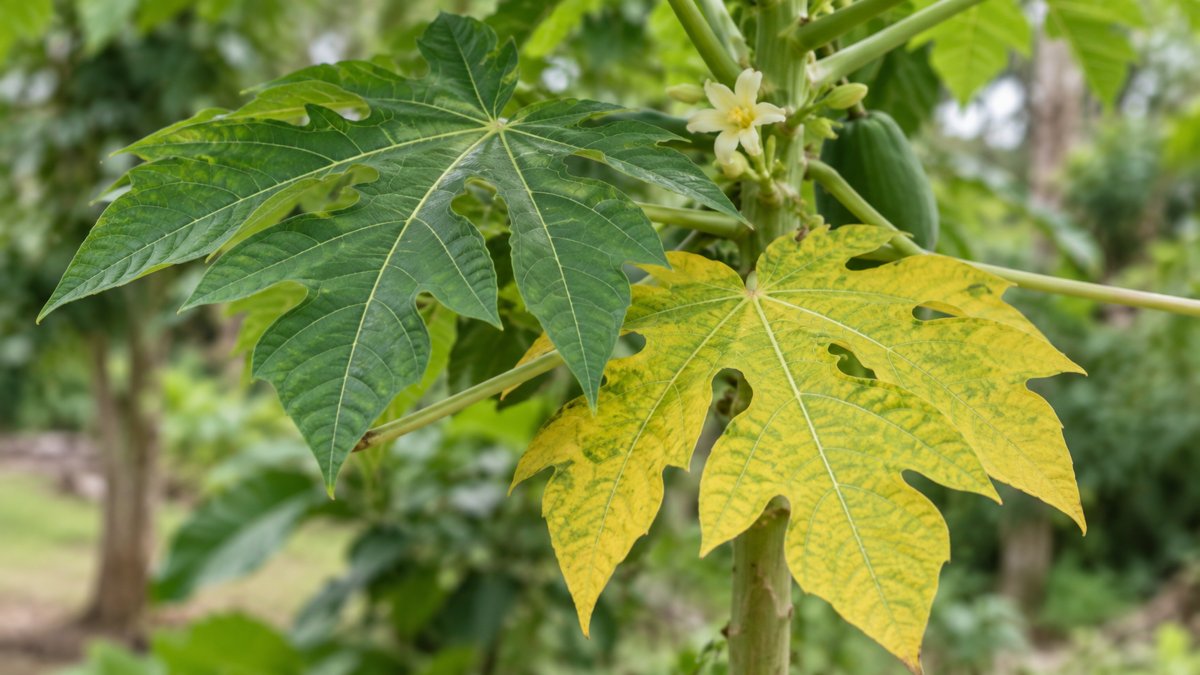
Papaya leaves may turn yellow for several reasons, and a tree that flowers without setting fruit can have a different issue from one that is losing leaves. Start by noting which leaves are affected, checking the undersides and soil, and looking closely at the flowers. Those observations help narrow the next step; none alone proves a specific deficiency, pest or disease.
How can I compare common causes of yellow papaya leaves?
| What you observe | A possibility to consider | What to check next |
|---|---|---|
| Older lower leaves yellow more evenly while new growth remains normal | Normal leaf ageing or a nutrient limitation, including nitrogen | Whether yellowing is limited to the oldest leaves or is spreading; review recent feeding and the whole plant |
| Yellowing with wilting, especially after rain or frequent watering | Roots under stress from persistently wet soil; root disease may also be involved | Whether water stands around the root zone, how quickly the soil drains, and whether the stem base or roots look damaged |
| Fine pale speckles or a dull, stippled leaf | Sap-feeding mites or other insects may be present | Inspect the underside of several affected leaves for mites, webbing or insects |
| Mottled, distorted or unusually small new leaves | A pest, virus or another growing stress may be involved | Compare new and older leaves and check for insects; get a local plant-health assessment if the pattern is spreading |
| Yellowing between veins while veins stay greener | A nutrient imbalance, including magnesium or iron availability, is one possibility | Check whether the same pattern appears on multiple leaves and consider soil or growing-medium conditions |
These are comparison clues, not a field diagnosis. Several stresses can occur together, and symptoms can look alike. Before adding a product, record the affected leaf age, pattern, recent weather and watering, and any fertilizer already applied.
Why can a papaya flower without setting fruit?
Look at the flowers rather than assuming that more fertilizer will solve the problem. Male flowers commonly occur in clusters on longer stalks and lack the ovary needed to develop into fruit. Female flowers have a more visible ovary at the base and need compatible pollen to set fruit. Hermaphroditic flowers have both male and female structures and may set fruit, but fruit shape and set can vary with cultivar and conditions.
| Flower or symptom | What it can suggest | Useful next check |
|---|---|---|
| Many small flowers on long, hanging stalks, with no swelling at the base | Male flowers; they generally do not develop into fruit | Inspect several flowers over time; do not judge the whole tree from one flower |
| Larger flower close to the trunk with a visible rounded base | Female flower; fruit set depends on pollination and conditions | Watch whether the base begins to enlarge after flowering |
| Flower with both stamens and a central pistil | Hermaphroditic flower, which can self-pollinate in some cultivars | Observe fruit set and shape; cultivar and local conditions matter |
| Flowers or small fruit drop during hot, dry or otherwise stressful weather | Environmental or plant stress may contribute | Review moisture consistency, drainage, recent weather and general plant health |
The presence of one flower type does not guarantee a harvest. If a tree repeatedly produces only male flowers, confirm the pattern across flowering periods and check the cultivar information before deciding whether to replant or change the planting mix. Avoid assuming that a particular cultivar pairing guarantees pollination.
What should I check in the soil and fertilizer routine?
Papaya roots can be affected by prolonged waterlogging. Check whether water drains away after rain and whether the root zone stays saturated. Depending on the site, growers may consider improving surface drainage, shaping a modest raised bed or mound, or incorporating mature compost to improve soil structure. The suitable approach depends on the soil and local rainfall; a high bed is not automatically necessary everywhere.
For fertilizer, use the Department of Agriculture’s 4R approach—right source, rate, time and place—rather than applying a fixed recipe to every tree [source]. Read the product label and take account of crop stage, soil, previous applications and the pattern of symptoms. Mature compost can support soil structure and biological activity [source], but it does not establish which nutrient a particular yellow leaf needs.
Fertilizer input costs can change over time; the available cost record reports a substantial 2026 increase [source]. Compare current product labels, pack sizes and quoted delivery costs before purchasing, and do not treat a general market report as a farm-specific budget.
If symptoms are spreading, the new growth is badly distorted, or roots are declining despite correcting obvious standing water, take clear photos of whole-plant symptoms and leaf undersides and ask a local crop adviser or plant-health service to assess the plant. Do not use a fertilizer enquiry as a substitute for disease diagnosis.
Read next: Papaya fertilizer buying guide
Frequently asked questions
Why are lower papaya leaves turning yellow?
Older lower leaves can yellow as part of normal turnover, but widespread yellowing or wilting also warrants checking wet soil and root health. A nutrient issue such as low nitrogen is one possibility; look at the pattern across several leaves and the growing conditions before changing fertilizer.
What do yellow spots or mottled young leaves mean?
Fine stippling, webbing or insects under leaves can point to sap-feeding pests such as mites or whiteflies. Mottling, distortion or unusually small new leaves can have other causes, including viral disease. These patterns are clues, not a diagnosis; compare several leaves and seek local plant-health advice if symptoms spread.
Why does my papaya flower but not produce fruit?
Flower structure matters. Male flowers usually grow on longer stalks and lack the ovary that develops into fruit; female flowers have a visible ovary, while hermaphroditic flowers contain both reproductive structures. Female flowers need compatible pollen to set fruit, and weather or plant stress can also affect flower retention.
Should I add a high-potassium fertilizer when papaya flowers?
Do not choose a formula or rate from flowering alone. Check the product label and consider the crop stage, soil, recent applications and symptoms together; the Department of Agriculture's 4R principle is to use the right source, rate, time and place [source].