
Yellow Leaves: How to Check the Symptom Before Adding Fertilizer
Decision details
Fits if: Growers who want to organise observations before requesting a plant assessment or a soil/leaf test.
Main drawback: Nutrient or liming recommendations without test results and crop context can miss the target.
Compare: Crop type, affected leaf part, symptom spread, irrigation, recent applications and analysis results.
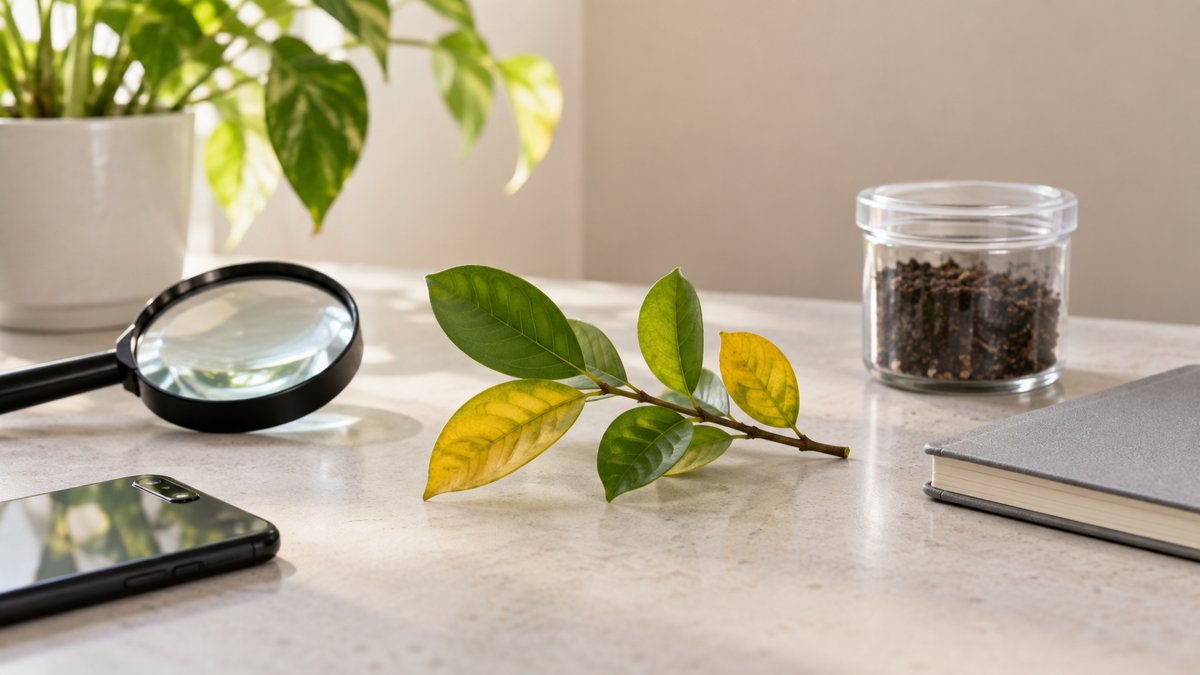
In this guide
What does a yellow leaf actually show: why is it not one specific deficit?
Leaf colour alone does not prove the plant lacks nitrogen, magnesium, iron or any other element. Leaves can change after water, roots, weather, transplanting, spraying, fertilizer or other problems shift. Patterns on the leaf may help an examination, but they are not a test and cannot produce a diagnosis without knowing the crop and its surroundings.
Before adding any input, record what can be checked: the plant/cultivar name if known, the plant’s age or stage as documented, which leaf part started changing, whether one plant or many are involved, and the date the symptom was first seen. Photograph the whole plant and close-ups of the same leaves over time. Do not discard the pesticide or fertilizer labels you used; record the product name and application date as printed on the label.
Which observation checks avoid making a diagnosis: the record table?
Use this list to prepare a conversation with an agriculture officer or laboratory — not to choose a treatment yourself:
| Observation | What to record | What it does not prove |
|---|---|---|
| Leaves involved | Old leaves, young leaves, edges, or whole leaves | Which nutrient is short |
| Symptom spread | One plant, one row, one area, or the whole plot | Disease or pest cause |
| Water and drainage | Recent rain/irrigation, standing water or dry soil as seen | Root moisture status without inspection |
| Management changes | Transplanting, pruning or products used, with dates | Cause and effect from timing coincidence |
| Supporting evidence | Photos, input labels, records and test results if any | A diagnosis if the sample or plant is misidentified |
Compare the affected plant with a healthy plant of the same type if available, but do not treat the difference as proof of cause. Keep the location and date for every observation. If symptoms spread fast, high-value crops are affected, or the condition worsens, contact the state/district agriculture office for examination guidance. Do not spray pesticide or change fertilizer dose based on generic symptom tables on the internet.
When might a soil or leaf analysis help: what does the DOA lab offer?
The Department of Agriculture Malaysia describes laboratory services covering soil, leaf, water and fertilizer sample analysis. The page, updated in 2015, states leaf analysis can be used to assess plant nutrient levels, soil fertility status and fertilizer needs [source]. Because that page’s information is dated, check the current sample scope and acceptance with the office or lab before sending; ask which sample types, how to take them, and which forms are required. DOA laboratory analysis service
Label samples with the crop, location and date, and follow the lab’s instructions. Do not sample one spot and assume it represents the whole farm unless the lab directs it. Lab results must be read together with the crop, location and purpose of the analysis; do not convert values into fertilizer doses without proper guidance.
Why does guesswork treatment make things worse: what does the 4R note say?
Do not spread lime just because leaves yellow, set a target pH value without results, or pick one element from a picture. Do not add concentrated fertilizer to “test” whether the plant recovers; extra applications blur the record and can worsen the condition. The Department of Agriculture states that adding more fertilizer does not necessarily make the crop better [source]. The DOA note on 4R
Information still needed to identify the cause includes the crop and cultivar, site history, symptom pattern, root/soil/water condition, products used, and examination or analysis results. Until that information exists, the honest verdict is: the cause is not yet known.
What does an honest page refuse to print: and what replaces it?
No element, no dose and no lime rate appear here — none can be earned without the record table above and a proper test. The observation table, the dated lab-service scope and the 4R principle are the working toolkit; the diagnosis belongs to the examination, not to the eye.
How do you prepare the sample and the story: what travels to the lab?
Photos over time, the input labels with dates, the affected-versus-healthy comparison, and the lab’s own sampling instructions. A sample without its story is just dirt; the same soil reads differently under different crops, histories and questions.
Where to buy: a physical agro shop nearby, or online?
The same fertilizer grade moves through two channels in Malaysia: the agro and farm-supply shops near you on one side, Shopee and Lazada storefronts on the other. Bulk bags usually work out cheaper at the physical agro shop, because freight pushes the online unit cost up; small foliar packs are usually easier to buy online. Both channels are legitimate — the difference is how you check and how you compute.
Before you pay on either channel, get these five things:
- A photo of the actual batch’s label — the container label of the batch that will actually reach you, not the catalogue image.
- The declared NPK, obtained by enquiry — not numbers read out of a listing title.
- Pack size and net weight in writing.
- A dated quote — fertilizer prices move; an old quote is not a comparison baseline.
- Registration or permit status, where the product class requires one.
The channel does not decide the grade: an online listing page is not a registration record, and a physical shop is not a guarantee of genuine stock. To compare across channels, use unit arithmetic — ringgit per kilogram for bagged and granular fertilizers, ringgit per litre for liquid foliar feeds — because face prices at different pack sizes do not compare directly.
NPK fertilizers can also be sourced through our supply channel on an enquiry basis — no published price, and we make no claim about its registration status [source]. Mention BETUL10 for 10% off your first order on WhatsApp; confirm the label, pack size, source and current price before you pay.
Read also: fertilizer hub
Frequently asked questions
A yellow leaf lacks which fertilizer element?
Yellow colour alone does not fix the element. Record the pattern and care history; determination needs crop information plus a suitable examination or analysis.
Should fertilizer be added straight away when leaves yellow?
Do not add dose on assumption. Check the last application's label and the soil/water condition first; the Department of Agriculture reminds growers that more fertilizer is not necessarily better.
Where can I ask about soil or leaf analysis?
The DOA describes laboratory services for soil, leaf, water and fertilizer samples [source]. Check the current acceptance scope and sample procedure with the office or lab before sending.