
How to Plant Banana Suckers: Planting Guide, NPK Schedules & Soil Preparation in Malaysia
Decision details
Fits if: Commercial banana orchardists (Berangan, Tanduk, Cavendish, Awak), smallholders, and home growers.
Main drawback: Over-applying nitrogen during early vegetative stages without balanced potassium causes weak pseudostems and increases susceptibility to Fusarium wilt (Panama disease) and wind snapping.
Compare: Sucker quality, planting hole drainage, soil pH (6.0–6.5), 4R fertilizer compliance, and desuckering management.
In this guide
How to plant banana suckers and tissue culture seedlings
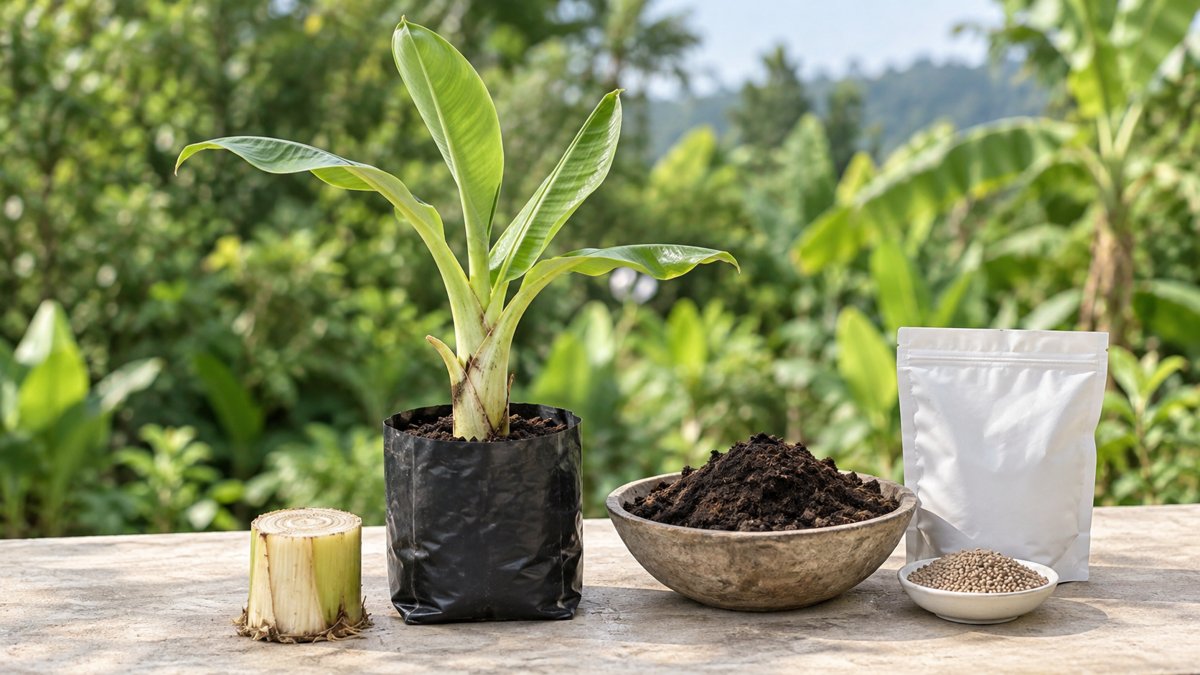
Establishing a productive banana stand begins with healthy planting material, whether using traditional sword suckers (anak sulur pedang) or certified tissue culture plantlets:
- Sword Sucker Selection: Choose vigorous sword suckers (40 cm to 80 cm in height) with narrow, blade-like leaves and conical corms. Broad-leaved water suckers (anak daun payung) should be avoided as they produce weaker root systems and delayed flowering.
- Corm Trimming and Sanitization: Pare away old roots, damaged tissue, and any dark lesions on the corm to eliminate nematode eggs and borer weevils before planting.
- Tissue Culture Hardening: Tissue culture plantlets require gradual acclimatization under nursery shade before field transplanting to reduce transplant shock and sun scorch.
- Planting Depth: Position the sucker upright with the corm collar set 5 cm to 10 cm below the natural ground surface, then firmly pack surrounding soil to eliminate subterranean air pockets.
Soil preparation, hole sizing, and dolomite conditioning
Bananas are heavy feeders requiring deep, well-drained loam rich in organic matter and an optimal soil pH of 6.0 to 6.5:
- Excavation Dimensions: Dig planting holes measuring 60 cm x 60 cm x 60 cm (2 ft x 2 ft x 2 ft) to allow unimpeded root proliferation.
- Basal Fertilizer Conditioning: Blend excavated topsoil with 5 kg to 10 kg of well-rotted organic manure and rock phosphate to stimulate early root branching.
- Dolomite Liming for Acid Soils: In acidic inland Malaysian soils (pH below 5.5), incorporate agricultural dolomite per hole at least 2 weeks prior to planting to neutralize excess acidity and supply essential magnesium.
- Drainage Channels: Construct inter-row drainage trenches in lowland plots to prevent waterlogging, which severely exacerbates corm rot and Erwinia bacterial soft rot.
| Growth Stage | Timing (Months After Planting) | Recommended Fertilizer Formula | Application Rate per Mat | Agronomic Focus |
|---|---|---|---|---|
| Planting (Basal) | Day 0 (At planting) | CIRP (Rock Phosphate) + Compost | Basal rock phosphate + organic matter | Root expansion and mycorrhizal colonization |
| Early Vegetative | Month 1 to Month 2 | NPK 15:15:15 or 16:16:16 | 50 g to 80 g / plant / month | Rapid leaf emergence and pseudostem girth |
| Mid Vegetative | Month 3 to Month 5 | NPK 15:15:15 + Magnesium (2MgO) | 80 g to 90 g / plant / month | Canopy expansion and structural rigidity |
| Floral Initiation (Shooting) | Month 6 to Month 7 | NPK 12-12-17+2MgO+TE | 80 g to 90 g / plant / round | Bunch bud differentiation and flower count |
| Fruit Filling & Maturation | Month 8 to Harvest (Month 10–12) | NPK 12-12-17+2MgO / SOP (K2SO4) | 80 g / plant (ring broadcast) | Finger elongation, pulp density & Brix sweetness |
Stage-by-stage banana fertilizer schedule and NPK ratios
Banana plants absorb high quantities of potassium (K) and nitrogen (N) throughout their lifecycle. The Malaysian Department of Agriculture emphasizes 4R nutrient stewardship—reminding growers that simply applying more fertilizer does not automatically result in better crops [source]:
- Vegetative Phase (Months 1–4): Equal-ratio NPK formulations (such as 15:15:15) applied in a ring 30 cm to 50 cm away from the pseudostem promote steady leaf unfurling (aiming for 30–40 healthy leaves before flowering).
- Reproductive Transition (Months 5–7): Switch to high-potassium blends (such as 12-12-17+2MgO) to support the emerging floral heart (jantung pisang) and ensure complete hand formation.
- Desuckering (Membuang Sulur): Maintain only 1 main follower sucker per mat during bunch development to prevent nutrient competition from depleting bunch weight.
Organic banana pseudostem mulch and soil enzyme recycling
With commercial synthetic fertilizer prices projected to remain elevated [source], recycling plantation biomass is vital for cost-efficient orchard management:
- Pseudostem Chopping: After harvesting the bunch, cut the parent pseudostem into 10 cm to 20 cm rings and distribute them evenly as mulch across the root zone.
- Soil Enzyme Activation: Organic residues stimulate native soil enzyme activity (such as cellulase, urease, and dehydrogenase) [source], accelerating natural organic matter decomposition and improving soil moisture retention during dry spells.
- Potassium Recycling: Decomposing pseudostem tissues return significant amounts of bio-available potassium and organic carbon into the soil, reducing synthetic potassium purchase requirements for subsequent ratoon cycles.
Baca juga: hub baja · baja-dolomite-untuk-pisang-en · baja-buah-untuk-pokok-pisang-dan-pokok-kelapa-en
Frequently asked questions
What is the ideal planting hole size for banana suckers in Malaysia?
The standard recommended hole size is 60 cm x 60 cm x 60 cm (2 ft x 2 ft x 2 ft), filled with a blend of topsoil, well-rotted organic compost, and Christmas Island Rock Phosphate (CIRP).
When should fertilizer first be applied after planting banana suckers?
Basal rock phosphate is applied at planting, while the first NPK topdressing (such as 15:15:15) begins 1 month after planting once active leaf unfurling confirms root establishment.
How can chopped banana stems (pseudostems) be reused as fertilizer?
Harvested banana trunks can be chopped and layered around the plant base as organic mulch, releasing stored potassium and elevating soil enzyme activity as they decompose.