
Japanese Cucumber Problems: Leaves, Fruit and Flowers Diagnosed
Decision details
Fits if: For Japanese cucumber growers who just saw a symptom and want to know what to check first.
Main drawback: No Malaysia-specific Japanese cucumber diagnosis pack exists in our fact registry — general principles with a need for local confirmation.
Compare: Plant part hit first, spreading pattern, that week's weather, and the latest water-fertilizer records.
In this guide
Summary: Japanese cucumber shows problems fast when care is inconsistent — and responds fast when you fix the cause. This page follows what your EYES see first (leaves, fruit, flowers, whole plant), with checklists by likelihood: yellow leaves usually tell a water story, not disease.
Leaves: yellowing, spotting or curling — which check order?
| Symptom | Common causes (check order) | Action |
|---|---|---|
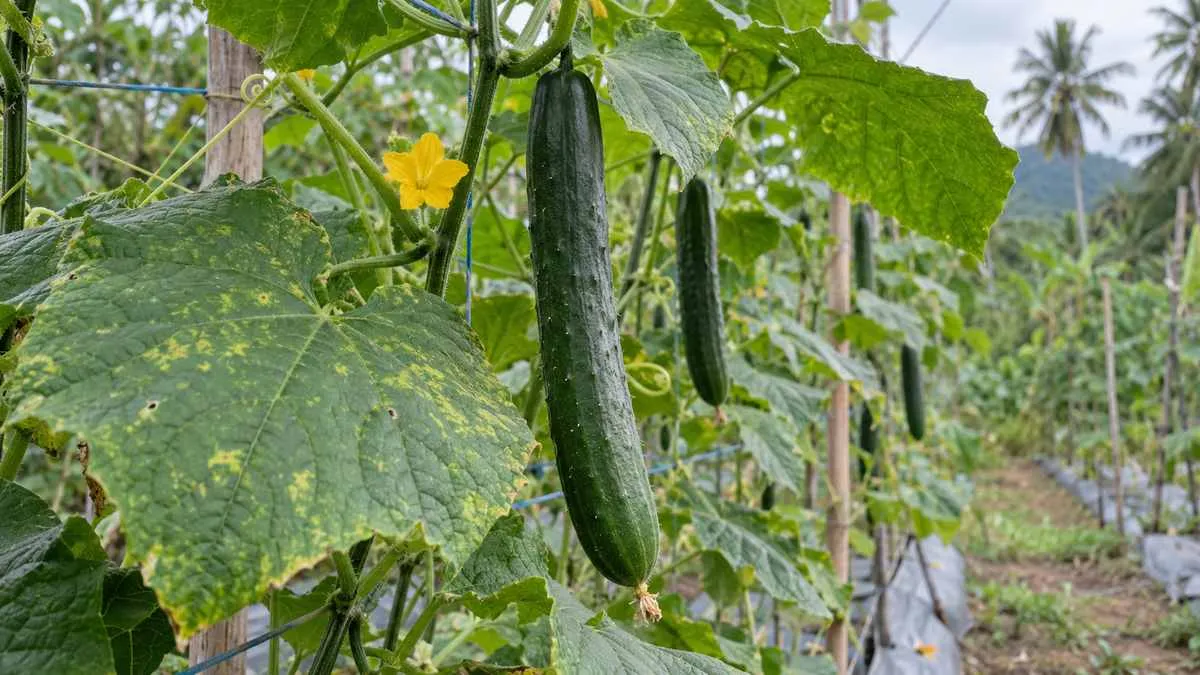
| Yellowing starts on lower leaves, climbs gradually | Nutrient decline late in cycle; inconsistent water | Check fertilizer records and water routine first |
| Powdery yellow-brown spots under leaves | Leaf-fungus class, fast in continuous damp | Remove worst leaves, open airflow, reduce overhead watering |
| Young leaves curled and sticky | Sap-sucking aphids on shoots | Remove worst shoots, patrol mornings, control the ants that “farm” aphids |
| Banded yellowing with sharp edges on all leaves at once | Follow-on from a spray or over-fertilizing | Check what changed that week before blaming disease |
Evidence rule: photograph every two days — the spread pattern separates fungus (slow, spot by spot) from water stress (all at once).
Fruit: curved, small, bitter or end-rot — what fixes the next round?
- Curved — incomplete pollination and inconsistent water; a half-pollinated flower becomes a half-shaped fruit.
- All small on a green plant — too many fruit at once or low light; green foliage is no guarantee of size.
- Bitter — heat-drought stress and late harvest; pick more often and earlier.
- End rot — the calcium-shortage class tied to inconsistent water; consistent watering beats additives.
Damaged fruit cannot be “restored”; your work is the next fruit set.
Flowers: dropping before fruit — what stress is the plant reporting?
Flowers are the most honest stress reporters: heat, water shortage or pollinator disturbance — they drop outright. Two quick checks: consistent water at flowering, and pollinator activity (bees, flower flies) in the morning. Spraying at flowering wipes out pollination — spray at night.
Whole plant: wilting — when is it water, when is it roots?
Midday wilt that recovers at night is ordinary water stress. Wilt unrecovered by morning is the root or stem disease class: pull the plant, inspect the roots (soft rot? lesions?), separate diseased plants, and do not replant the same hole. For the wider family, see cucumber problems.
Japanese cucumber price: what must every offer record?
Record date, location, product, unit, grade, quantity and delivery charges. A retail display is labelled retail; a farm offer keeps grading terms and delivery point.
The FULL commodity list of the FAMA Daily Price Guide (full reading 27/9/2026, 38 rows including non-vegetable classes): AYAM HIDUP; AYAM PROSES STANDARD; AYAM PROSES SUPER; BAWANG BESAR KUNING/HOLLAND; BAWANG BESAR MERAH (IMPORT); BAWANG BESAR MERAH (INDIA); BAWANG MERAH/KECIL (IMPORT); BAWANG MERAH/KECIL (INDIA); BAWANG MERAH/KECIL (THAI); BAWANG MERAH ROSE; BAWANG PUTIH (CHINA); BAYAM; BETIK SEKAKI; CILI HIJAU; CILI HIJAU (IMPORT); CILI MERAH (CHINA); CILI MERAH (IMPORT); CILI MERAH (THAILAND); CILI MERAH KULAI/KULAI HIBRID; CILI MERAH MINYAK; DAUN BAWANG; DAUN SUP (TANAH TINGGI); KACANG BENDI; KACANG BUNCIS; KACANG PANJANG HIJAU; KANGKUNG; KUBIS BULAT (CHINA); KUBIS BULAT (INDONESIA); KUBIS BULAT (TANAH TINGGI); PISANG BERANGAN; PISANG MAS; SAWI HIJAU TANAH TINGGI; TELUR AYAM (RM/biji); TEMBIKAI MERAH TANPA BIJI; TERUNG PANJANG/PEPARU (TANAH RENDAH); TIMUN HIJAU; TOMATO (TANAH TINGGI); UBI KENTANG HOLLAND. NOT listed (the FAMA daily price cannot fill the slot): durian, manggis, rambutan, mempelam, limau, nenas, markisa, anggur, strawberi, jagung, kobis selain kubis bulat, terung bulat, terung asam, timun batang, timun jepun, lobak, labu, petola, ketola, kundur, peria, salad/selada, halia, kunyit, serai, lengkuas, kesum, pudina, misai kucing, tongkat ali, cendawan, sentul, tebu, kuini, cempedak, nangka, betik selain sekaki, pisang selain berangan/mas, orkid, bunga ros, getah, koko, padi. [source]
Timun jepun sits in the NOT-listed group — no daily FAMA row exists. For your own check, see the price guide and PriceCatcher.
Per-kilo price checks: how do you compare like with like?
Check whether the price is per net kilo or another pack weight. Compare equivalent quality and type; record normal and promotional prices separately. Without a date, an old figure is not today’s price.
| Comparison basis | Information recorded |
|---|---|
| Product | Cucumber name and type as stated |
| Unit | Per kilo, pack or other unit as offered |
| Market | Farm, wholesale or retail |
| Date and place | Check date and actual location |
Planting cost and profit for timun jepun: transactions only?
Build the list from real transactions: planting material, site preparation, water and system, inputs, labour, grading, packaging and delivery. Separate start-up from per-cycle costs; no Japanese-cucumber-specific price or yield is verified here.
Compute sales after the buyer accepts yield and pays per the agreed terms; subtract costs already paid, including rejects and delivery. Unharvested or unsold yield is a projection, not profit. The cassava planting cost layout is another example, not Japanese cucumber figures.
Fertilizer guidance for timun jepun: what is checked first?
Check soil, drainage, water and growth before choosing inputs. Record whether a change hits a few leaves or the whole plant; leaf looks alone do not confirm a shortage.
| Check | Record | General decision |
|---|---|---|
| Soil | Moisture and drainage | Fix clear water problems first |
| Plant | Old leaves, shoots and fruit set | Watch the pattern, not one leaf |
| Product | Crop and use method on the label | Follow the suitable label |
| After application | Change in new growth | Avoid changing many factors at once |
Confirm the system — soil, containers or soil-less — and check the label names the crop, content, application method and safety steps for it; do not buy a “fast fruiting” claim. Leaf colour alone does not determine cause: inspect roots, media, water and drainage, and whether symptoms are local or spreading. If symptoms began after a product, record it.
| Note | What is observed |
|---|---|
| Symptom | Plant part affected and whether the symptom is spreading |
| Site | Water, drainage, soil or media condition |
| Input | Product name plus time and method of application |
| Follow-up | Change in growth after the note was made |
Read also: cucumber problems · fertilizer hub
Frequently asked questions
My Japanese cucumber leaves are yellow — why?
Top three causes: inconsistent water (dry-weak alternating), disturbed roots (waterlogging or nematodes), and nutrient decline late in the cycle. Check in that order before spraying anything — yellowing is a symptom, not a diagnosis.
Japanese cucumber fruit is curved — can it be fixed?
Fruit already curved will not straighten; what can be corrected is the cause: incomplete pollination, inconsistent water, or overly shaded leaves. Curved fruit is still edible at home — but the market grade rejects it.
Why do flowers drop before becoming fruit?
Flower drop usually tells a stress story: extreme heat, water shortage at flowering, or insects disturbing pollination. Dropped flowers cannot be saved — manage conditions for the next flower cluster.
What makes Japanese cucumber bitter?
Bitterness rises when the plant is stressed — heat, drought, or late harvest. Consistent water and picking on time are the most effective prevention.
What is the price of Japanese cucumber per kilo?
No dated price is verified in this fact registry. Check offers on a specific date and location, then state the market stage and unit.
Is the market price the same as what the grower receives?
Do not assume so. Wholesale or retail markets are not proof of a farm price; check the buyer, grade, deductions and delivery costs separately.
Which fertilizer suits Japanese cucumber?
No specific product or rate is verified here. Check the label and crop suitability, and get extension advice if needed.
Can I follow ordinary cucumber fertilizer rates?
Do not assume the rates are the same without guidance that names the variety or growing system concerned.
How do I monitor fertilizing?
Record the product, application time and growth condition afterwards. Change one factor at a time.