
Jambu Air Citra: How to Grow Malaysia's Sweet Wax Apple
Decision details
Fits if: Commercial orchardists, smallholders, and home gardeners with well-drained loam or raised garden beds.
Main drawback: Excessive nitrogen fertilizer or waterlogging during flowering causes heavy blossom drop and reduces fruit sweetness.
Compare: Full sun exposure, well-aerated soil structure, balanced potassium fertilization during fruit sizing, and timely pest bagging.
In this guide
How to grow Citra wax apple (cara tanam jambu air citra) and orchard establishment
Establishing a productive Citra wax apple planting in Malaysian conditions involves several key initial steps:
- Selecting Clonal Saplings: Choose vegetatively propagated saplings via marcotting (tut) or cleft grafting rather than growing from seeds. Clonal plants remain true to type, develop a manageable canopy, and fruit within 2 years.
- Planting Hole Preparation: Excavate planting holes measuring 60x60x60 cm spaced at 5x5 meters or 6x6 meters. Mix topsoil with 5 to 10 kg of well-rotted cattle manure or organic compost and 0.2 kg of ground magnesium limestone (GML/dolomite) to raise soil pH to 5.5–6.5.
- Transplanting Technique: Carefully slice the polybag without disturbing the root ball. Place the sapling upright, backfill with amended soil, firm gently, and stake with bamboo to prevent wind lodging.
- Mulching and Moisture Conservation: Apply a 5 cm layer of dry grass, wood shavings, or chopped banana pseudostem around the drip line (keeping 10 cm clear of the trunk) to conserve soil moisture and suppress weed competition.
Stage-by-stage fertilizer schedule: vegetative, flowering, and fruit-swelling
Wax apple trees are heavy feeders during flushing and fruit set, requiring targeted nutrient ratios at each developmental stage:
- Vegetative Stage (Months 1–18): Apply NPK 15:15:15 compound fertilizer in split ring applications every 2 to 3 months to build a strong canopy framework.
- Flower Induction & Budding: 2 months prior to the expected flowering window, reduce nitrogen and apply NPK 12-12-17+2MgO or mono-potassium phosphate (MKP) foliar sprays to arrest vegetative flushes and trigger floral differentiation.
- Fruit Development & Sizing: Once fruitlets set, supply potassium-rich formulas alongside trace calcium and boron to prevent fruit cracking during heavy tropical rainfall.
| Growth Stage | Tree Age / Phase | Fertilizer Formulation | Dosage & Application Rate | Key Field Action |
|---|---|---|---|---|
| Field Establishment | 1 to 6 months | NPK 15:15:15 + Organic Compost | 0.05–0.1 kg/tree every 6–8 weeks | Keep soil consistently moist; stake against wind |
| Canopy Development | 7 to 18 months | NPK 15:15:15 + Trace Elements | 0.15–0.25 kg/tree every 2 months | Formative pruning to establish open-center vase canopy |
| Pre-Flowering Induction | Adult tree (post-pruning) | NPK 12-12-17+2MgO + Boron | 0.3–0.5 kg/tree (single ring band) | Withhold excess water for 2 weeks to stress blooms |
| Fruitlet Set & Swelling | Pea to marble size | NPK 12-12-17+2MgO + Calcium | 0.4–0.6 kg/tree in split doses | Thin clusters to 3–4 fruitlets; bag against fruit flies |
| Pre-Harvest Ripening | 2 to 3 weeks before harvest | Sulfate of Potash (SOP / 0-0-50) | 0.2–0.3 kg/tree (light dressing) | Reduce watering slightly to concentrate sugar brix |
Fruit bagging, pruning, and anthracnose disease management
Producing high-grade commercial Citra wax apples requires proactive canopy hygiene and physical crop protection:
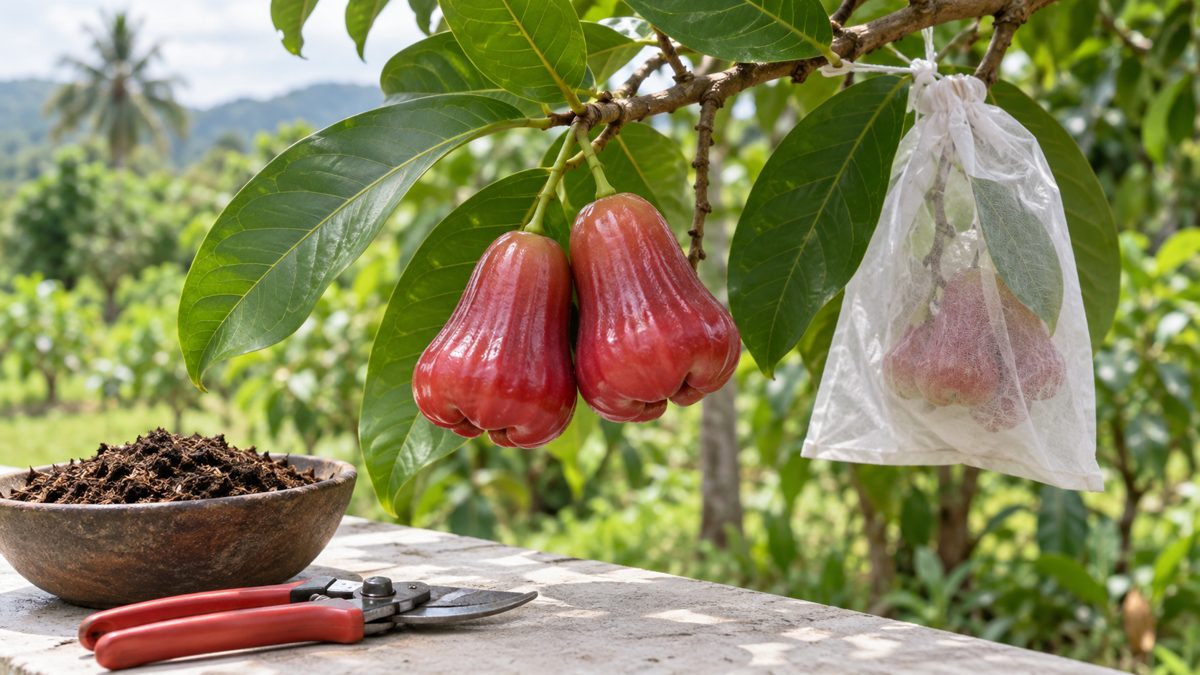
- Cluster Thinning and Bagging: Citra wax apple naturally sets dense clusters of 10 to 15 fruitlets. Thin aggressively, retaining only the 3 to 4 largest, well-shaped fruits per cluster. Bag each cluster using breathable paper or non-woven UV-resistant fruit protection bags when fruits reach marble size to prevent oviposition by oriental fruit flies (Bactrocera dorsalis).
- Canopy Pruning: Maintain an open-center vase structure with tree height capped at 2.5 to 3.0 meters. Remove water sprouts, crossing internal branches, and diseased twigs to ensure maximum sunlight penetration and air circulation.
- Anthracnose and Fruit Rot Prevention: High tropical humidity promotes fungal anthracnose (Colletotrichum gloeosporioides). Ensure proper field drainage, avoid overhead sprinkler irrigation during flowering, and prune lower skirt branches touching the ground.
Baca juga: hub baja · baja-untuk-jambu-batu-en · penyakit-antraknosa-pada-jambu-air-en
Frequently asked questions
How long does a Citra wax apple tree take to bear fruit in Malaysia?
Air-layered (marcotting) or grafted Citra wax apple saplings typically begin flowering and fruiting within 18 to 24 months after field transplanting under tropical Malaysian conditions.
What is the best fertilizer for flowering and sweet fruit in jambu air?
Transitioning from balanced NPK 15:15:15 during vegetative stages to high-potassium NPK 12-12-17+2MgO at floral bud emergence promotes firm fruit flesh and higher sugar content.
When should jambu air fruit clusters be bagged on the tree?
Bagging should be carried out using breathable paper or non-woven fabric bags when fruitlets reach the size of small marbles, immediately after thinning to 3 to 4 fruits per cluster.