
Fertigation & Hydroponics Guide: AB Nutrient Formulations, Rock Melon Systems & Tank Management
Decision details
Fits if: High-value crop growers cultivating rock melon, chili, ginger, and greenhouse hydroponic vegetables seeking high water-use efficiency.
Main drawback: Never mix concentrated Stock A (calcium nitrate/iron) and Stock B (phosphates/sulfates) together in raw form; direct mixing causes calcium sulfate and calcium phosphate precipitation, permanently blocking drippers.
Compare: Water quality and baseline EC, nutrient tank agitation and sizing, crop phenology EC adjustment, and micro-tubing filtration.
In this guide
Fertigation systems deliver water and essential mineral nutrients simultaneously through micro-irrigation networks, reducing leaching losses and water wastage [source]. With rising agricultural input costs across global fertilizer markets, closed and semi-closed fertigation setups provide commercial Malaysian growers with precise control over crop feeding cycles [source].
| System Component | Key Specifications & Standards | Operational Role | Management Protocol |
|---|---|---|---|
| Stock AB Nutrient Solutions | Separate Stock A (Ca, Fe-EDTA) & Stock B (P, K, Mg, Sulfates) [source] | Complete macro and micronutrient feeding [source] | Never mix concentrates; dilute into final irrigation tank [source] |
| Rock Melon Polybag Setup | 16x16 inch cocopeat bags, 1 dripper per bag [source] | Rootzone aeration and moisture retention [source] | Single-fruit pruning, trellis staking, EC 1.8 to 2.5 mS/cm [source] |
| Nutrien Mixing Tank | HDPE black tank, fine disc filter, submersible agitator | Buffer solution preparation and pressurization [source] | Maintain pH 5.5-6.5, calibrate digital EC meter weekly [source] |
AB Nutrient Formulations for Hydroponics and Fertigation (Baja AB Hydroponics Fertigasi)
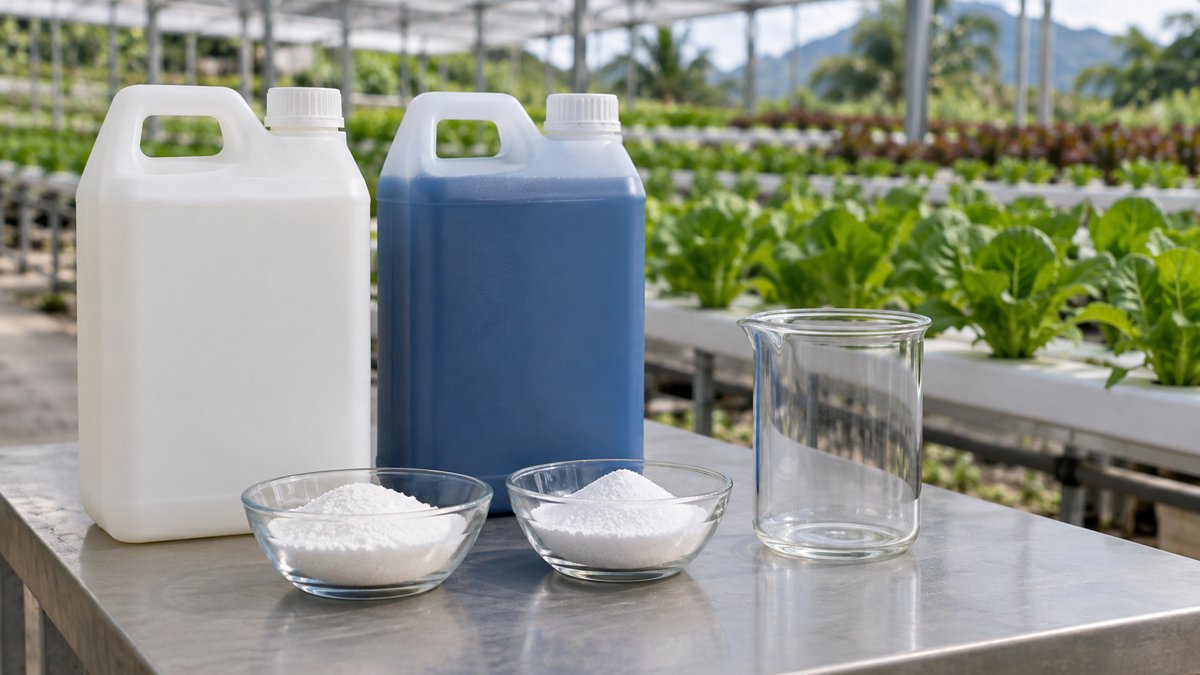
The cornerstone of modern soilless cultivation is the AB fertilizer formulation, designed to supply all sixteen essential plant elements in fully soluble forms [source]. Stock A is formulated primarily with Calcium Nitrate and chelated Iron (Fe-EDDHA or Fe-EDTA), while Stock B contains Potassium Nitrate, Mono-Potassium Phosphate (MKP), Magnesium Sulfate, and trace elements including Zinc, Boron, Copper, Manganese, and Molybdenum [source].
The strict rule in fertigation chemistry is that Stock A and Stock B concentrates must never be mixed together in the same preparation bucket [source]. When concentrated calcium ions meet concentrated sulfate and phosphate ions, they react chemically to precipitate out insoluble calcium sulfate (gypsum) and calcium phosphate, rendering the nutrients unavailable to plants and instantly clogging micro-tubing drippers [source]. Concentrates must always be added separately into the large irrigation water tank to reach the targeted operational EC and pH 5.5-6.5 [source].
How to Cultivate Rock Melon via Fertigation (Cara Tanam Rock Melon Fertigasi)
Rock melon (Cucumis melo) is one of the most profitable cash crops cultivated under Malaysian rain shelter structures using fertigation polybag systems. Seedlings are germinated in peat moss plug trays for 10 to 12 days before being transplanted into 16x16 inch polybags filled with treated, washed cocopeat [source]. The crop requires full tropical sunlight, consistent ambient aeration, and strict protection against heavy rains to prevent fungal leaf anthracnose and downy mildew [source].
As the vine climbs vertical polypropylene trellises, all lateral side shoots are pruned up to node 8. Lateral shoots between nodes 9 and 12 are allowed to flower for hand or bee pollination. Once fruit set occurs, growers select the single most symmetrical fruit per vine and prune off all secondary melons to direct all photosynthetic energy into one premium melon [source]. Nutrition is adjusted according to the 4R stewardship principles, raising the feeding concentration from EC 1.8 during early growth to EC 2.2-2.5 during the fruit expansion and netting phase [source].
Fertigation Nutrient Tank Setup and System Management (Tangki Nutrien Fertigasi)
A reliable fertigation system relies on properly sized and maintained nutrient storage tanks [source]. Most commercial farms utilize dark-colored polyethylene (HDPE) tanks of adequate capacity to store the final working nutrient solution while blocking sunlight penetration to inhibit green algae proliferation. The tank system incorporates automatic float valves connected to clean farm water lines, an inline disc filter, and digital automated timer controllers linked to high-head water pumps.
Routine tank maintenance requires checking electrical conductivity (EC) and pH levels before every daily irrigation cycle [source]. In tropical heat, evaporation can concentrate salts in the tank, requiring dilution with raw water to prevent osmotic root burn. Monthly flushing of the main lateral irrigation lines and regular cleaning of secondary disc filters prevent biofilm accumulation and ensure uniform delivery of fertilizer across all polybag rows [source].
Baca juga: hub baja · bagaimana-cara-memulai-berkebun-hidroponik-di-rumah · bagaimana-cara-sederhana-membuat-hidroponik-di-rumah-atau-se
Frequently asked questions
Why must Fertilizer Stock A and Stock B be dissolved in separate tanks?
Stock A contains calcium and iron, while Stock B contains phosphates and sulfates. Concentrated mixing causes insoluble calcium sulfate (gypsum) and calcium phosphate precipitates that clog drip emitters.
What is the recommended EC range for fertigated rock melon in Malaysia?
Rock melon typically starts at EC 1.5-1.8 mS/cm during the vegetative stage, increases to EC 2.2-2.5 mS/cm during netting and fruit enlargement, and is adjusted down before harvest to enhance sweetness.
How should fertigation nutrient tanks be maintained against algae and sediment?
Tanks should be opaque (black or dark blue) to block sunlight, fitted with inline disc filters, and flushed regularly to remove salt sedimentation.