
Fertigasi Atas Meja: Complete Guide to Tabletop, Hanging Wire & Pipe Layout Fertigation Systems
Decision details
Fits if: For urban and mobility-limited growers deciding between ground-level bags and bench systems.
Main drawback: Bench frames and automation raise capital cost; yields depend on the same nutrient discipline as ground systems.
Compare: Space height, budget, mobility needs, and automation level.
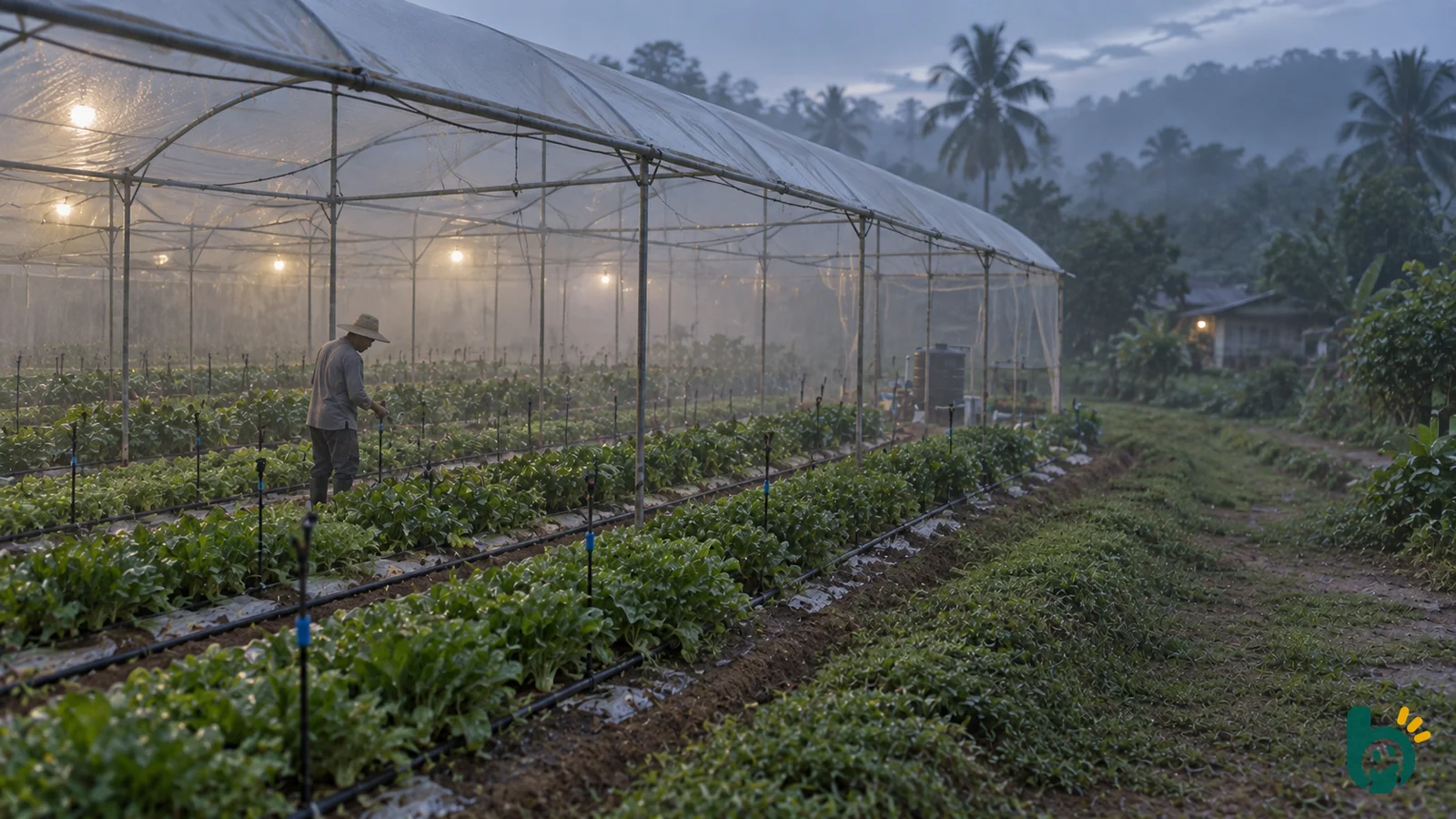
In this guide
What does fertigation mean in English, and what are its core engineering components?
In agricultural terminology, fertigation combines two essential horticultural practices:
- Fertilization: Supplying macro and micronutrients needed for vegetative growth, flowering, and fruiting.
- Irrigation: Regulated artificial application of water to maintain root-zone moisture.
A complete Malaysian commercial fertigation setup consists of five primary hardware components:
- Nutrient Reservoir & Mixing Tanks: Separate Set A (Calcium Nitrate and Iron chelates) and Set B (Phosphates, Potassium, and trace elements) stock formulations, such as the Department of Agriculture standard recipe [source].
- Water Pump & Inline Filtration: Submersible or centrifugal pumps fitted with disc/screen filters to prevent micro-dripper clogs.
- Distribution Piping: Polyethylene (PE) main and sub-main tubing connected via standardized 1/2-inch (16 to 17 mm) barbed fittings [source].
- Precision Micro-Drippers: Micro-tubes punched into sub-mains using 2 mm punch assemblies [source] and anchored with arrow drippers.
- Automation Timers & Solenoids: Digital controllers that trigger pulse irrigation matching crop transpiration schedules.
What is tabletop bench fertigation (fertigasi atas meja) and why is it used?
Tabletop fertigation (fertigasi atas meja / para) mounts cultivation containers onto sturdy waist-high platforms (typically 60 to 90 cm above ground level):
- Physical Pathogen Barrier: Elevating polybags above ground weedmat prevents rain splash from carrying destructive soil microbes like Ralstonia solanacearum (bacterial wilt) and Phytophthora into lower leaves.
- Root Zone Aeration: Air circulates freely beneath the polybags, improving bottom drainage and preventing root rotting from standing floor puddles.
- Worker Ergonomics: Pruning, trellising, spraying, and harvesting occur at standing height, reducing physical fatigue and increasing daily labor productivity.
| Configuration Type | Structural Setup | Key Agronomic Advantage | Ideal Commercial Crops |
|---|---|---|---|
| Tabletop Bench (*Atas Meja*) | Elevated steel/PVC waist-high benches | Maximum pathogen isolation & ergonomic efficiency | Rockmelon, cherry tomatoes, premium chili |
| Hanging Wire (*Dawai Gantung*) | Overhead galvanized steel suspension cables | Zero floor contact; adaptable to uneven terrains | Highland strawberries, climbing vine crops |
| Closed-Loop Ring (*Gegelang*) | Looped continuous sub-main pipeline | Uniform emitter pressure from start to end | High-density greenhouse chili polybags |
| Radial System (*Jejari*) | Central manifold branching outward | Simple modular installation for standard plots | Open-field polybag vegetable beds |
How does suspended hanging wire fertigation (dawai fertigasi gantung) work?
Hanging fertigation replaces ground benches with tensioned overhead galvanized steel cables (typically 2.5 mm to 3.2 mm high-tensile wire) anchored to greenhouse frames or sturdy end-posts:
- Weight Bearing: Heavy-duty polybags or specialized trough gutters are suspended from overhead cables using UV-resistant S-hooks and nylon slings.
- Space Optimization: Suspended lines allow multiple vertical tiers in high-roof greenhouses and simplify floor sanitation because weedmats remain unobstructed by table legs.
- Vibration & Wind Management: Requires robust anchor tensioning to prevent swaying under heavy fruit loads.
What is the difference between radial (jejari) and closed-loop ring (gegelang) piping layouts?
Proper hydraulic design ensures every plant receives identical nutrient volumes regardless of its distance from the pump:
- Closed-Loop Ring System (Sistem Gegelang): The sub-main piping loops completely around the planting perimeter and rejoins itself. Because water enters from two directions, friction loss is minimized and pressure remains balanced across all dripper emitters.
- Radial System (Sistem Jejari): Water flows from a central manifold into multiple parallel lateral branches. While simpler to install, laterals exceeding 30 meters can experience pressure drop toward the tail end, requiring pressure-compensating (PC) drippers.
Why is Bentong ginger (fertigasi halia Bentong) cultivated using polybag fertigation?
Bentong ginger (Zingiber officinale) is a high-value Malaysian crop traditionally prone to catastrophic soil-borne ginger soft rot (Pythium) and bacterial wilt.
Transitioning to polybag fertigation revolutionizes commercial ginger production:
- Sterile Growing Media: Utilizing pure cocopeat and treated rice husk biochar in 16 × 16-inch polybags [source] completely eliminates soil-borne nematode and fungal infestations.
- Targeted Nutrient Influx: High-potassium liquid fertigation stimulates rapid, thick rhizome expansion without waterlogging the fibrous root zone.
- Predictable Harvest Cycles: Ginger grown in fertigated polybags reaches mature commercial grade (8 to 9 months) with uniform, clean rhizomes that command premium market prices.
Automated vs passive unpowered fertigation systems: Which should you choose?
- Digital Automated Drip: Employs electronic AC/DC timer solenoids that run 5 to 8 short nutrient pulses daily. For intensive crops like chili, commercial budgets demonstrate that precise input control maintains input costs around RM4.40 per polybag per season [source], adhering strictly to the 4R Nutrient Stewardship principles [source].
- Passive Gravity / Float Valve Systems (Nirdaya): Uses gravity-fed reservoirs and smart sub-irrigation valves (such as Autopot systems) that supply water on demand based on plant transpiration without needing electrical power or pumps, ideal for off-grid rural homesteads.
Baca juga: hub baja · bahan-untuk-tanaman-fertigasi · cili-fertigasi-cost
Frequently asked questions
What is tabletop bench fertigation in modern farming?
Tabletop fertigation is a method of growing crops in polybags or troughs elevated onto waist-high benches with automated drip nutrition delivery.
What does the term fertigation mean in English?
Fertigation is a portmanteau of fertilization and irrigation, referring to the practice of injecting soluble plant nutrients directly into the irrigation water stream.
What is the difference between radial (jejari) and closed-loop ring (gegelang) piping systems?
Radial systems branch outward from a central line, while closed-loop ring systems connect the piping in a complete loop to equalize water pressure across every emitter.
Why is Bentong ginger grown using polybag fertigation?
Polybag fertigation uses sterile cocopeat substrate, isolating high-value ginger rhizomes from devastating soil-borne bacterial wilt and fungal pathogens.