
Durian Tree Health: Root Problems, Flower Drop and Storm Damage
Decision details
Fits if: Commercial durian orchardists, estate managers, and smallholders cultivating premium varieties (D197 Musang King, D200 Black Thorn, D24) in Malaysia.
Main drawback: This guide cannot diagnose disease or guarantee fruit set, storm protection, grade or margin; use site observations and local advice before changing inputs or orchard structures.
Compare: Tree age and bearing stage; drainage and root symptoms; flower/fruit-drop timing; leaf pattern; pollinator and variety context; site-specific storm exposure; dated market references.
In this guide
What is the best fertilizer for a durian tree?
There is no single best grade for every tree. For planning, Malaysia’s DOA page recommends small amounts 4–6 times a year for young trees and 3–4 times for mature trees [source]. For fruiting durian in Penang, the state agriculture department lists NPK 12:12:17:2+TE or 13:13:20:2+TE across three annual applications; treat that as a Penang schedule, not a national formula [source] [source]. Before buying, match the tree’s age and bearing stage to local guidance, then compare the full grade, pack size, quantity for the confirmed schedule and delivered total.
akar durian busuk
Durian root decline can have more than one cause. Persistent waterlogging, compaction or a low-lying planting position can reduce aeration and stress roots; soil-borne pathogens such as Phytophthora, Pythium and Fusarium may also be involved. These are possibilities to investigate, not a diagnosis from canopy symptoms alone. Gradual canopy thinning, pale leaves, branch dieback or gum at the trunk base are useful observations to record, but an inspection is needed to identify the cause.
Where water is visibly ponding or draining poorly, discuss options such as improving surface drainage, mounding new or affected plantings where appropriate, and adding suitable organic matter with a local agronomist. The right action depends on soil, slope, water flow and neighboring land; drainage channels or mounds can redirect water and should not be applied as a universal prescription. Compost and soil-biological products also vary, so confirm their role and suitability for the site [source].
| Observation | Possible contributors | What to check | Conditional next step |
|---|---|---|---|
| Root or canopy decline | Waterlogging, poor aeration, compaction or possible soil-borne disease | Where water stands; affected roots, trunk base and pattern of canopy change | Get the cause assessed; consider drainage, mounding or organic matter only where site conditions support it |
| Flowers or ovaries drop | Stage, weather, water changes, pollination or nutrient conditions may be relevant | When drop occurs relative to bloom; rain, irrigation, new shoots and recent inputs | Record the pattern; investigate likely causes before changing fertilizer or applying a spray |
| Flowers appear but fruit does not set | Pollination, flowering overlap, variety or other orchard conditions | Flowering times, varieties present and pollinator activity | Discuss locally suitable pollinator habitat, compatible varieties or assisted pollination; no pairing or method guarantees set |
| Yellow leaves | Possible nutrient issue, root stress or another condition | Older versus newer leaves; uniform versus interveinal pattern; curling, wilting or dieback | Use the pattern to guide assessment; confirm a cause before changing nutrients or soil pH |
| Fruit loss after a storm | Wind exposure and branch or fruit-stalk loading may contribute | Exposed rows, affected branches, fruit stage and prior support | Ask whether selective support or a windbreak suits the site; neither guarantees retention |
kenapa bunga durian gugur
Flower and ovary drop has several possible drivers, and timing helps narrow what to investigate. Rain around flower-cluster emergence may coincide with vegetative flushing; new shoots can compete with developing flowers or fruit for the tree’s resources. Pollination and nutrient conditions may also be relevant, but a falling flower does not establish a deficiency or justify a foliar spray.
- Record the stage: Note whether buds, open flowers, ovaries or young fruit are dropping, along with weather, irrigation and fertilizer history.
- Consider water and shoot growth: Sudden changes in water availability or a vigorous new flush may be part of the picture; check the pattern before changing irrigation.
- Investigate nutrition rather than guessing: Boron, calcium or other nutrients may matter to reproductive development, but the cited DOA package does not diagnose your orchard’s drop. Seek local advice and a confirmed basis before applying micronutrients or reducing nitrogen.
kenapa pohon durian berbunga tapi tidak berbuah
When flowers appear but fruit does not set, pollination is one possible factor alongside flowering conditions, weather and variety. Durian flowers open in the evening and may be visited by nocturnal pollinators, including bats and moths; activity and fruit set vary by site. The DOA material cited here describes an ovary dropping within 7–10 days after bloom when pollination and fertilization do not occur, rather than a universal 48-hour window [source].
- Pollinator context: Record pollinator activity and avoid assuming that a single insect or a single intervention explains the outcome. Discuss any pesticide use during flowering with a qualified local adviser and follow product directions.
- Variety context: Flowering overlap and cross-pollination may be worth discussing where a block has poor set. Ask locally which varieties and timing are compatible; this page does not endorse a named pairing or promise a higher set rate.
- Assisted pollination: Hand pollination may be an option in some orchards, but timing and technique are site-specific and success is not guaranteed. Ask an experienced local adviser before treating it as a solution.
penyakit durian daun kuning
Leaf yellowing is a symptom, not a diagnosis. The pattern can help an adviser decide what to check:
- Older leaves: Interveinal yellowing, with greener veins, can be consistent with a magnesium-related issue, among other causes.
- Broad pale colour: Uniform paleness across leaves or canopy can be consistent with a nutrient or root-uptake problem; it does not by itself confirm nitrogen deficiency.
- Curling, wilting or dieback: If these accompany yellowing, include roots, water conditions and trunk lesions in the assessment.
Record which leaves are affected and how the pattern changes. Confirm the cause before adding magnesium, nitrogen or other nutrients, applying chemicals, or changing soil pH [source].
rugi beratus durian muda gugur dipukul ribut
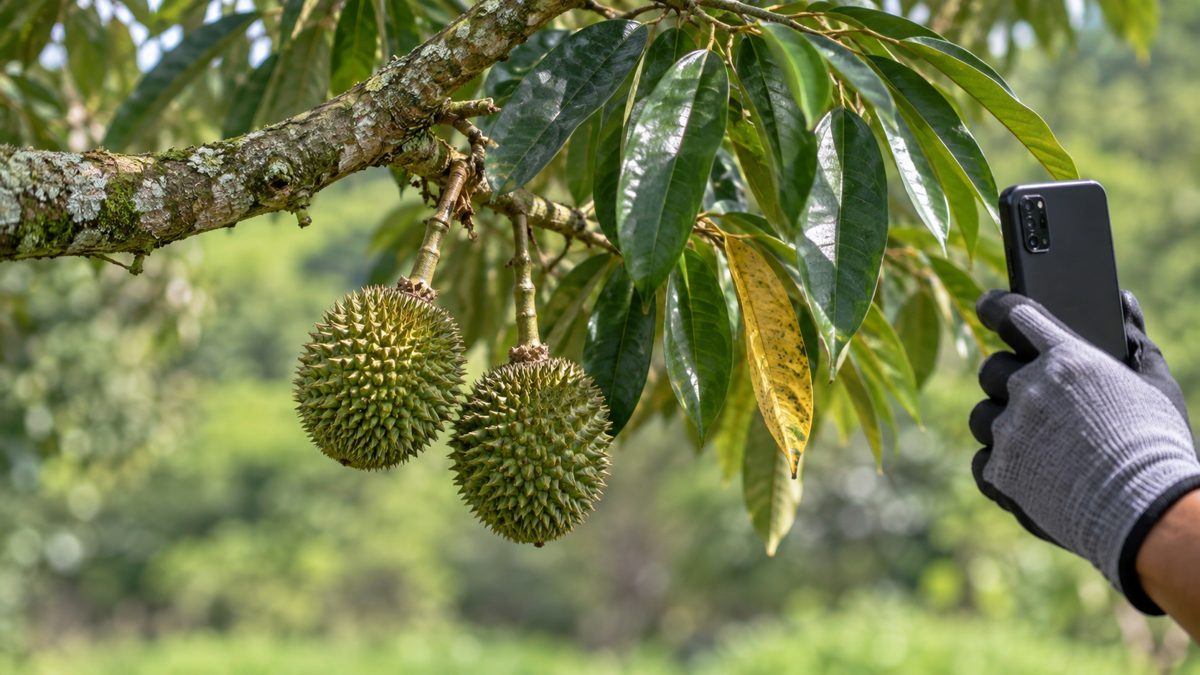
Storms can damage exposed branches and developing fruit, but this page has no comparative loss rate or proven protection method. Wind exposure, branch structure, fruit stage and crop load all affect what support might be appropriate.
- Assess the site: Record which rows and branches were affected, the fruit stage and visible damage. Ask a local orchard adviser whether a windbreak or selective support for fruiting branches is suitable; avoid attaching ties to weak branches or using a method without site guidance.
- Treat tying as conditional: Support may reduce movement in some circumstances, but it can also stress a branch or fruit stalk if poorly placed. Confirm attachment points and material with an experienced adviser, and do not treat tying as a guarantee against fruit loss.
- Keep market and production risk separate: Dated market records can help growers track price variation [source] [source], but they do not ensure a grade, premium price or margin after input costs [source].
A mature durian tree has no flowers: a different question
Do not treat a tree that has never flowered as though it has post-bloom drop. The DOA Durian Technology Package (2012) describes what can happen after flowering: an ovary may drop within 7–10 days if pollination and fertilization do not occur [source]. It also notes that, about four weeks after bloom, excess water can encourage shoots that compete with young fruit and may contribute to fruit drop [source]. Those historical stage observations do not diagnose why a mature tree has no flowers or prescribe a watering or fertilizer treatment. Record the tree’s age, variety, season and care history, then discuss the case with a local DOA officer or agronomist.
Baca juga: hub baja · durian-organic-fertilizer-en · how-to-fertilize-durian-trees-en · baja-durian-belanda-en · baja-organik-untuk-anak-pokok-durian-en
Frequently asked questions
What causes root rot (akar busuk) in durian trees?
Waterlogging and poor aeration can stress roots and may favor soil-borne pathogens, including Phytophthora and Pythium, and possibly Fusarium; other causes are possible. Yellowing, dieback or gum at the trunk base warrants closer inspection but does not identify a pathogen by itself. Record where and when symptoms occur and seek a local plant-health assessment before treatment.
Why do durian flowers fall off before developing into fruit?
Flower drop can have several possible drivers. Rain and new vegetative shoots may coincide with competition for the tree’s resources; pollination and nutrient conditions may also matter. The cited DOA material covers post-bloom stages, not a diagnosis of blossom drop. Record the stage, weather, irrigation and inputs before deciding what to investigate [source] [source].
What if a mature durian tree does not flower at all?
A tree that has never flowered is different from an ovary or fruitlet dropping after bloom. The DOA's 2012 package describes post-bloom stages only: an unpollinated ovary may drop within 7–10 days after bloom [source], and excess water about four weeks after bloom can encourage new shoots that compete with young fruit [source]. These observations do not identify why a tree has no flowers. Record tree age, variety, season and care history, then ask a local agriculture officer for guidance.
How can orchardists protect developing young durians from storm damage?
Support or tying may be worth discussing for exposed fruiting branches, but a method that suits one tree or fruit stage may not suit another. Ask a local orchard adviser to assess branch strength, attachment points and storm exposure; tying cannot guarantee that fruit will be retained.