
Oyster Mushroom Substrate Nutrition in Malaysia (Baja Cendawan Tiram): Formulations & Yield Guide
Decision details
Fits if: Mushroom farm operators, cottage industry cultivators, and agricultural smallholders growing grey or white oyster mushrooms in Malaysia.
Main drawback: Never apply chemical fertilizer pellets or high-pressure sprays directly into bag necks; chemical salinity and pooled water rot pinheads and trigger Trichoderma mold.
Compare: Substrate carbon-to-nitrogen ratio, moisture squeeze test, atmospheric steam pasteurisation, and environmental relative humidity maintenance.
In this guide
baja cendawan tiram
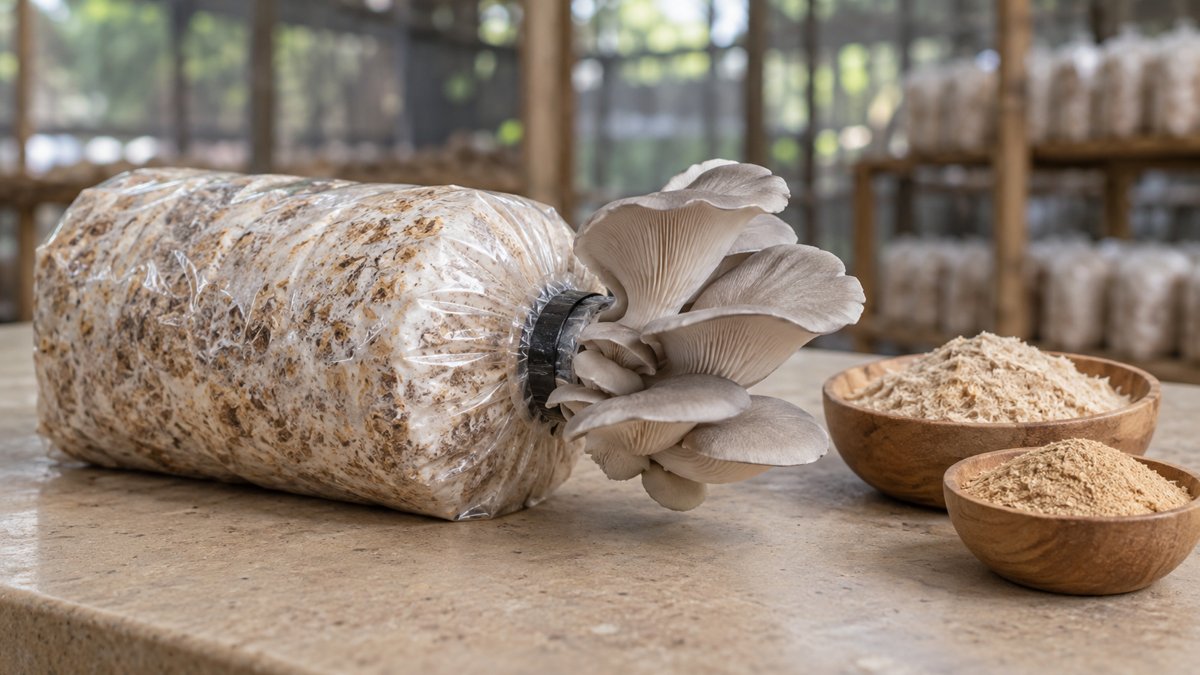
Oyster mushrooms (Pleurotus pulmonarius and Pleurotus ostreatus) are saprophytic organisms that feed through extracellular enzymatic digestion. In tropical commercial sheds across Malaysia, growers formulate substrate bags (bongkah cendawan) that provide balanced nutrition throughout multiple harvesting flushes:
- Primary Carbon Carrier (Rubberwood Sawdust): Clean sawdust from aged rubberwood (Hevea brasiliensis) serves as the primary carbon matrix. Fungal mycelium secretes cellulase and ligninase enzymes to break down woody fibers into simple absorbable sugars [source].
- Organic Nitrogen and Protein Booster (Fine Rice Bran): Fresh fine rice bran (dedak padi halus) supplies organic nitrogen, lipids, and B-complex vitamins. This protein boost accelerates mycelial colonization and increases harvest weights per flush.
- Acidity Buffer and Calcium Supply (Agricultural Lime): Calcium carbonate (kapur pertanian) buffers organic acids released during fungal respiration, maintaining an optimal substrate pH while providing essential calcium ions for cell wall strength.
- Moisture Matrix: Clean water is blended until the substrate reaches optimal moisture. When a handful is squeezed firmly, it should hold together in a firm ball without excess water dripping through the fingers.
| Substrate Ingredient | Standard Commercial Role | Nutritional Function | Quality Benchmark & Handling |
|---|---|---|---|
| Rubberwood Sawdust (Habuk Kayu Getah) | Bulk carbonaceous base matrix | Supplies cellulose and lignin for fungal enzyme breakdown [source] | Sieve to remove sharp splinters; avoid treated timber |
| Fine Rice Bran (Dedak Padi Halus) | Organic nitrogen and protein enrichment | Drives rapid mycelial colonization and fruiting density | Must be fresh and sweet; avoid rancid or mite-infested bran |
| Agricultural Lime (CaCO3) | Mineral pH buffer and calcium source | Neutralizes metabolic acids and strengthens hyphal walls | Conforms to agricultural input standards [source] |
| Projected Commercial Fertilizer Bag | Macro-agricultural cost comparison | Benchmark for conventional crop inputs reaching up to RM350 [source] | Highlights the cost advantage of organic milling by-products |
Step-by-step substrate preparation and pasteurisation in Malaysia
Producing high-yielding mushroom bags requires strict hygiene and thermal processing:
- Dry Blending: Thoroughly mix sieved rubberwood sawdust, fine rice bran, and agricultural lime in dry form to ensure uniform distribution.
- Moisture Incorporation: Gradually add clean water while turning the heap until the substrate passes the hand-squeeze test.
- Bagging and Neck Ring Assembly: Pack the damp substrate firmly into cylindrical polypropylene (PP) bags, compress lightly to eliminate large air pockets, and install plastic neck rings with breathable sponge caps.
- Atmospheric Steam Pasteurisation: Load bags into steam drums or concrete chambers and steam under steady heat for six to eight hours to eliminate competing wild fungal spores and bacteria.
- Aseptic Inoculation & Incubation: Allow bags to cool completely before inoculating with grain spawn (benih cendawan) in a clean room. Transfer bags to a dark, well-ventilated incubation room for forty to fifty days until mycelium fully colonizes the sawdust.
Humidity management and avoiding green mold contamination
Once bags turn completely white, the neck caps are opened to initiate fruiting:
- Microclimate Humidity Control: Use fine misting nozzles on shed floors, mesh netting, and walkways three to four times daily to maintain high ambient relative humidity without shooting water directly into open bag collars.
- Air Circulation: Ensure continuous fresh air exchange. High carbon dioxide accumulation results in deformed mushrooms with thick, elongated rubbery stems and tiny caps.
- Preventing Green Mold (Trichoderma harzianum): Avoid adding excessive rice bran (exceeding fifteen percent of dry weight), which creates an overly rich, hot medium prone to green mold outbreaks.
- Post-Harvest Cleaning: After harvesting each cluster, scrape away dead root tissue from the bag neck and allow the bag to rest for seven to ten days before resuming misting. Sourcing mushroom cultivation accessories, mist nozzles, and polypropylene bags can be done via Shopee [source].
Baca juga: hub baja · harga-cendawan-busut-sekilo-en · harga-cendawan-butang-tin-en
Baja cendawan tiram
What nutrients do oyster mushrooms (cendawan tiram) actually need?
Oyster mushrooms (Pleurotus pulmonarius and Pleurotus ostreatus) are saprophytic fungi that obtain nutrition through extracellular enzymatic decomposition. In natural forest environments, fungal mycelium colonises fallen hardwood logs, secreting cellulases, hemicellulases, and lignin peroxidases to break complex woody polymers into simple absorbable sugars [source].
When cultivated commercially in Malaysia, this natural ecological process is replicated inside heat-resistant polypropylene substrate bags (bongkah cendawan). The mushroom mycelium requires four essential dietary components:
- Carbon and structural energy base: Rubberwood sawdust (habuk kayu getah) provides the bulk carbonaceous matrix, consisting of cellulose, hemicellulose, and lignin. Clean, well-aerated sawdust gives the mycelium structural support and sustained carbohydrates throughout multiple fruiting flushes.
- Organic nitrogen and protein booster: Fine rice bran (dedak padi halus) acts as the primary protein supplement. Nitrogen from rice bran provides the building blocks for amino acids, nucleic acids, and enzymes essential for vegetative mycelial extension and robust pinhead formation.
- Mineral pH buffer and calcium supply: Agricultural lime (kapur pertanian or calcium carbonate) neutralises organic acids released during fungal metabolism, maintaining an optimal substrate pH while supplying calcium ions for fungal cell wall integrity.
- Moisture matrix: Clean water acts as the transport medium for dissolved nutrients and fungal enzymes. Proper moisture allows mycelial hyphae to penetrate sawdust particles without suffocating aerobic respiration.
Applying standard chemical fertilizers—such as granular urea or high-salt NPK mixtures—directly into substrate bags or onto live mycelium is detrimental. High osmotic pressure and rapid chemical salt accumulation desiccate fungal hyphae and cause severe mycelial dieback. Commercial mushroom nutrition must follow organic substrate blending principles.
How is the commercial substrate mixture (baja bongkah cendawan) formulated?
Formulating mushroom substrate bags requires balancing the carbon-to-nitrogen ratio. If nitrogen levels are too low, mycelium growth remains weak and flush weights drop. If nitrogen levels are excessively high, substrate temperature spikes during incubation and opportunistic competitor molds overwhelm the bag.
In Malaysian mushroom houses, commercial growers rely on standardized formulation batches:
- Sieved rubberwood sawdust: Fresh sawdust from local sawmills must be sieved to remove large splinters, bark fragments, and foreign debris. Sawdust from softwood or treated construction timber containing chemical preservatives must never be used.
- Fine rice bran: Fresh, sweet-smelling rice bran is blended evenly through the dry sawdust. Stale or rancid rice bran containing storage mites and airborne spores increases contamination risks.
- Agricultural lime: Calcium carbonate powder is mixed thoroughly while dry to ensure uniform pH distribution across every bag.
- Moisture balancing test: Clean water is gradually incorporated while turning the heap. Experienced growers check moisture using the standard hand-squeeze test: when a handful of substrate is squeezed firmly, it should hold its shape in a cohesive ball without water dripping between the fingers, and crumble gently when touched.
+-------------------------------------------------------------------------+
|                  TYPICAL COMMERCIAL SUBSTRATE PROPORTIONS               |
|                                                                         |
|  [ Clean Rubberwood Sawdust ] ~ Base Structural Carbon Carrier          |
|                 +                                                       |
|  [ Fresh Fine Rice Bran ]     ~ Nitrogen & Protein Enrichment           |
|                 +                                                       |
|  [ Agricultural Lime ]        ~ Calcium Buffer & pH Neutraliser         |
|                 +                                                       |
|  [ Clean Well/Tap Water ]     ~ Moisture Matrix for Hyphal Enzyme Action|
+-------------------------------------------------------------------------+
Step-by-step pasteurisation and inoculation schedule in Malaysia
Successful oyster mushroom farming requires strict thermal processing to eliminate wild spore competitors before introducing commercial grain spawn (benih cendawan).
Step 1: Substrate bagging and compaction
The thoroughly blended substrate is packed into cylindrical polypropylene bags using a plastic neck ring and cap. The substrate must be compressed firmly to eliminate internal air pockets while maintaining enough pore space for gas exchange. A central inoculation hole is punched down the middle of the bag using a clean wooden or stainless steel peg.
Step 2: Atmospheric steam pasteurisation
Bags are loaded into insulated steaming drums or concrete pasteurisation chambers. Steaming ensures that competing wild fungi, bacteria, nematodes, and insect eggs within the sawdust and rice bran are neutralised. After reaching peak temperature, the bags are held under steady steam for several hours before allowing the chamber to cool gradually.
Step 3: Aseptic grain spawn inoculation
Once the substrate bags cool down completely to ambient room temperature inside a clean room, commercial grain spawn (typically grown on sterilized sorghum, wheat, or broken rice grains) is introduced through the neck opening. Inoculation must be performed rapidly under clean, draught-free conditions using flame-sterilised spoons or clean tools to prevent airborne green mold contamination.
Step 4: Dark mycelial incubation (fasa pemeraman)
Inoculated bags are transferred to a dark, clean incubation room with good air circulation and moderate ambient temperatures. Over several weeks, white fungal mycelium spreads outward from the grain spawn, thoroughly colonising the sawdust particles until the entire bag turns solid white and firm.
Substrate Blending ---> Bagging & Necking ---> Steam Pasteurisation ---> Aseptic Inoculation ---> Dark Incubation Run ---> Fruiting House Induction
Substrate breakdown and yield comparison for grey oyster mushrooms
Understanding the distinct function and risk factors associated with each input helps growers maintain high yields and avoid crop failures:
| Substrate Component | Material Used in Malaysia | Nutritional & Physical Role | Preparation & Handling Note |
|---|---|---|---|
| Primary carbon base | Rubberwood sawdust (habuk kayu getah) | Supplies structural cellulose, hemicellulose, and lignin for enzymatic digestion | Sieve to remove sharp splinters; avoid resinous or chemically treated timber |
| Nitrogen & protein booster | Fine rice bran (dedak padi halus) | Supplies organic nitrogen, amino acids, and B-vitamins for mycelial speed and yield | Must be fresh and dry; rancid or mite-infested bran causes contamination |
| pH buffer & calcium source | Agricultural lime / Calcium carbonate | Maintains neutral substrate pH and provides calcium for hyphal wall strength | Mix evenly through dry sawdust before adding water to prevent hot spots |
| Moisture & humidity control | Clean misting water (kabus air) | Hydrates fungal cells and sustains enzymatic nutrient transport | Use clean water source; avoid heavy dripping directly into open bag collars |
| Supplemental nutrient liquid | Dilute amino acid / seaweed spray | Provides micronutrient support across later flushes when applied to shed floors | Apply only as environmental mist; do not saturate standing pinheads |
Can liquid foliar boosters prolong harvest flushes?
Once substrate bags are fully colonised and transferred to the fruiting shed, growers open the caps to initiate fruiting (buka penutup bongkah). A typical oyster mushroom bag produces between three to five distinct harvesting flushes over its economic lifespan.
Growers frequently ask whether commercial liquid fertilizers or foliar booster sprays can be applied to revive tired substrate bags. The agronomic reality is governed by fungal biology:
- Environmental relative humidity: Mushrooms consist predominantly of water. High relative humidity in the growing house prevents premature drying of emerging pinheads (primordia). Misting floors, netting, and walkways with fine nozzles maintains a humid microclimate without soaking the bag mouths.
- Risks of direct chemical spraying: Spraying concentrated foliar fertilizers directly into the open bag neck can cause severe bacterial blotch (Pseudomonas infection), causing mushroom caps to turn yellow, slimy, and foul-smelling.
- Supplemental organic mists: Applying very dilute organic amino acid liquids or fermented plant extracts onto the walls and surrounding atmosphere of the shed provides mild ambient humidity with trace organic compounds. However, standard agronomic principles emphasize that proper initial substrate formulation determines total harvest potential [source].
- Scraping and resting between flushes: After harvesting a mature cluster of oyster mushrooms, growers must scrape away dead tissue and root remnants (korek pulut/pangkal tangkai) from the bag opening. Allowing the bag to rest for several days in moderate humidity before resuming active watering stimulates a clean, uniform subsequent flush.
Mature Flush Harvested ---> Scrape Residual Stems Clean ---> Rest Bag in Moderate Air ---> Resume Humidity Misting ---> New Pinheads Emerge
Common substrate mistakes and contamination risks in mushroom houses
Maintaining strict sanitation and balanced substrate inputs protects mushroom operations from sudden financial losses:
- Excessive rice bran proportions: Inexperienced growers sometimes add excess rice bran hoping to accelerate harvests. Over-enriching the substrate creates a nutrient-heavy environment that allows fast-growing green mold (Trichoderma harzianum) to outcompete mushroom mycelium during early incubation.
- Water accumulation inside bag collars: When watering fruiting houses, direct high-pressure hose streams can force water into the bag neck. Stagnant water trapped against the compressed sawdust rots the core and aborts delicate pinheads.
- Inadequate pasteurisation holding times: Shortening steam cycles to save firewood or gas leaves heat-resistant bacterial endospores and fungal spores viable, leading to widespread bag contamination during incubation.
- Poor ventilation in fruiting sheds: Oyster mushrooms require fresh air exchange. Inadequate ventilation causes high carbon dioxide accumulation, resulting in deformed mushrooms with thick, elongated rubbery stems and tiny, stunted caps.
Economics and sourcing substrate inputs in Malaysia
Managing input costs is critical for maintaining profitable smallholding and commercial mushroom enterprises. In the broader agricultural input sector, commodity price shifts have impacted raw material economics across Malaysia, with general agricultural fertilizer bags experiencing significant market fluctuations [source] [source] [source].
Because commercial mushroom production utilizes forestry and milling by-products rather than imported synthetic compounds [source], sourcing reliable local supplies of clean rubberwood sawdust and fresh rice bran remains the primary cost determinant. Many commercial growers source mushroom supplies, polypropylene bags, and plastic neck rings conveniently through online platforms like Shopee [source].
By mastering clean substrate preparation, precise moisture balance, and attentive microclimate control, Malaysian mushroom growers can achieve consistent, high-quality oyster mushroom harvests across every production cycle.
Where to buy: a physical agro shop nearby, or online?
The same fertilizer grade moves through two channels in Malaysia: the agro and farm-supply shops near you on one side, Shopee and Lazada storefronts on the other. Bulk bags usually work out cheaper at the physical agro shop, because freight pushes the online unit cost up; small foliar packs are usually easier to buy online. Both channels are legitimate — the difference is how you check and how you compute.
Before you pay on either channel, get these five things:
- A photo of the actual batch’s label — the container label of the batch that will actually reach you, not the catalogue image.
- The declared NPK, obtained by enquiry — not numbers read out of a listing title.
- Pack size and net weight in writing.
- A dated quote — fertilizer prices move; an old quote is not a comparison baseline.
- Registration or permit status, where the product class requires one.
The channel does not decide the grade: an online listing page is not a registration record, and a physical shop is not a guarantee of genuine stock. To compare across channels, use unit arithmetic — ringgit per kilogram for bagged and granular fertilizers, ringgit per litre for liquid foliar feeds — because face prices at different pack sizes do not compare directly.
NPK fertilizers can also be sourced through our supply channel on an enquiry basis — no published price, and we make no claim about its registration status [source]. Mention BETUL10 for 10% off your first order on WhatsApp; confirm the label, pack size, source and current price before you pay.
Frequently asked questions
Do oyster mushrooms require chemical NPK fertilizers?
No, oyster mushrooms obtain all required carbohydrates, proteins, and minerals directly from organic substrate blends of aged rubberwood sawdust, fine rice bran, and agricultural lime.
What is the primary organic nitrogen source used in mushroom substrate bags?
Fresh fine rice bran serves as the primary protein and nitrogen booster to promote rapid mycelium colonisation and dense fruiting body clusters.
Can liquid nutrient sprays be applied directly onto growing oyster mushrooms?
Mushroom growing sheds require fine ambient water misting for relative humidity, but spraying chemical liquid fertilizers directly onto fruiting pinheads causes bacterial blotch and rot.
Do oyster mushrooms require traditional NPK chemical fertilizers?
No, oyster mushrooms obtain all required nutrients directly from organic substrates such as rubberwood sawdust supplemented with fine rice bran and agricultural lime.
What is the main nutritional supplement added to mushroom substrate bags?
Fine rice bran serves as the primary protein and nitrogen booster to promote rapid mycelium colonisation and healthy fruiting body flushes.
Can foliar nutrient sprays be applied directly onto growing oyster mushrooms?
Mushroom houses require fine water misting for relative humidity, but heavy chemical sprays directly onto fruiting pinheads should be avoided to prevent bacterial blotch.