
NPK Fertilizer Dosage for Dragon Fruit in Malaysia: Growth Stages, Rates & Yields
Decision details
Fits if: Commercial dragon fruit orchardists, pitaya smallholders using trellis posts, and backyard fruit growers.
Main drawback: Applying concentrated fertilizer directly against the central post base causes severe shallow root burn and stem rot.
Compare: Vine development stage, post climbing status, flowering flush frequency, and certified fertilizer label compliance.
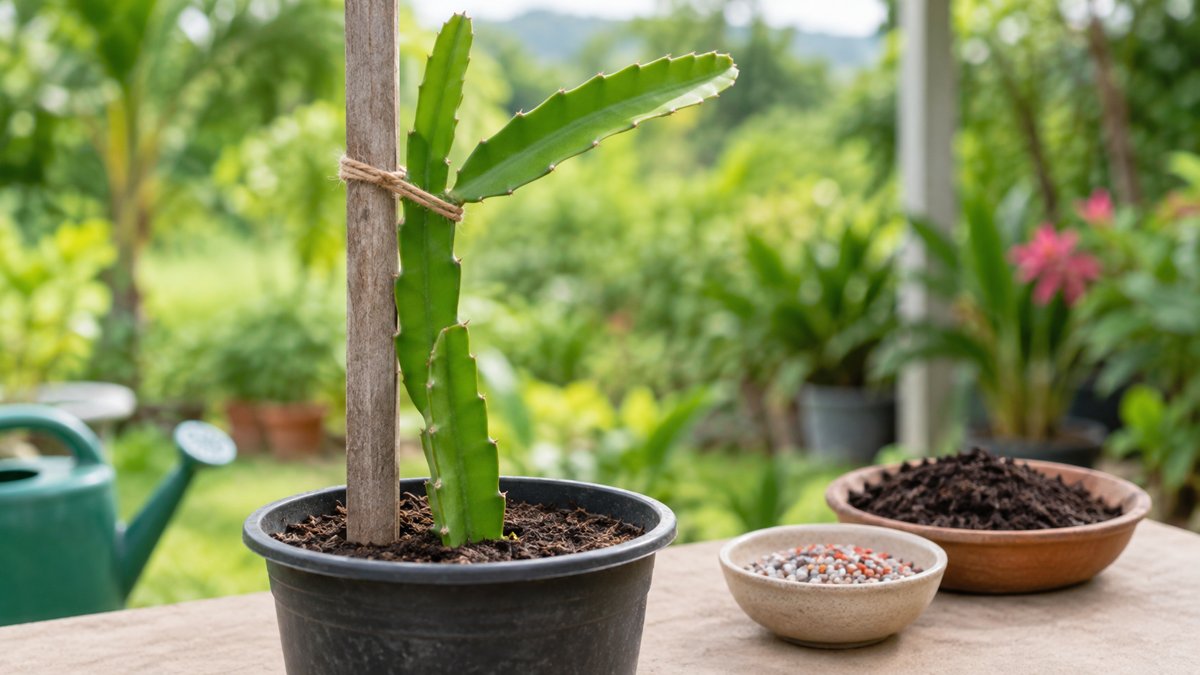
In this guide
What is the recommended NPK fertilizer dosage and schedule for dragon fruit?
Dragon fruit is a climbing hemi-epiphytic cactus with adventitious, shallow feeder roots concentrated in the upper 15cm to 30cm of soil. In Malaysia’s tropical climate, vines produce multiple successive flowering waves from April through November, requiring a disciplined nutrient program tailored to physiological growth stages:
- Vegetative Establishment & Trellis Climbing (Months 1 to 10):
- Nutrient Objective: Drive rapid stem elongation, cladode thickness, and extensive root proliferation up the central climbing post.
- Nutrient Dosage: 100g to 150g of balanced compound granular fertilizer (such as NPK 15:15:15 or NPK 16:16:16) per post every four to six weeks, combined with cured compost.
- Canopy Branching & Floral Induction (Months 11 to 15):
- Nutrient Objective: Encourage cascading canopy umbrella growth and initiate dense floral bud set along mature drooping branch tips.
- Nutrient Dosage: 200g of moderate-phosphorus, balanced compound fertilizer per post, supplemented with trace micronutrients (zinc, boron, magnesium).
- Active Flowering & Fruit Bulking (Bearing Phase):
- Nutrient Objective: Maximize fruitlet retention, pulp sweetness (brix), and peel thickness to resist sunscald and mechanical damage.
- Nutrient Dosage: 200g to 300g of high-potassium compound fertilizer (such as NPK 12:12:17+2MgO) per post applied in split monthly intervals.
| Growth Stage & Crop Phase | Target NPK Formulation | Dosage per Trellis Post | Application Method & Frequency |
|---|---|---|---|
| Young Vine Climbing (M1–M6) | NPK 15:15:15 + Cured compost | 100g NPK + 2kg compost | Monthly ring application around post |
| Canopy Umbrella Formation (M7–M12) | NPK 16:16:16 + Trace elements | 150g NPK per post | Every 6 weeks under dripline |
| Flower Bud Initiation | NPK 12:12:17+2MgO | 200g NPK per post | Post-pruning / early bud emergence |
| Fruitlet Bulking & Sizing | NPK 12:12:17+2MgO + Boron | 250g–300g NPK per post | Monthly during active fruit swelling |
| Post-Season Maintenance | Compost + NPK 15:15:15 | 2kg compost + 150g NPK | Post-harvest canopy rest period |
How should fertilizer be applied to protect shallow dragon fruit roots?
Because dragon fruit feeder roots reside near the surface, improper fertilizer placement can quickly cause root scorch and fungal stem rot:
- Canopy Dripline Broadcasting: Always scatter granules evenly across the soil surface within the vine dripline radius (50cm to 100cm away from the central trellis post). Never pile fertilizer against the post base.
- Moist Soil Application: Apply fertilizers immediately after rainfall or irrigate gently following application to dissolve granules into the soil solution without salt burn.
- Organic Mulch Layer: Maintain an organic mulch layer composed of dried palm fronds, chopped grass, or spent mushroom compost over the root zone. Mulch regulates soil temperature and boosts beneficial soil enzyme activities such as cellulase and protease [source].
Fertilizer cost management and statutory standards in Malaysia
With agricultural fertilizer prices experiencing steep market shifts where costs have risen by over 120%[source] across cycles and projected 25kg compound bags reaching RM350[source], pitaya growers maintain strict efficiency:
- DOA 4R Stewardship: The Malaysian Department of Agriculture emphasizes applying the Right Source, Right Rate, Right Time, and Right Place, noting that over-fertilizing does not automatically improve fruit yield and risks root toxicity [source].
- Official Label Standards: Sourcing products compliant with statutory standards, such as the Sabah Agriculture Fertilizer Enactment 2025, guarantees verified nutrient analysis on packaging [source].
- Import Certificate of Analysis: Reviewing an authentic Certificate of Analysis (CoA) for premium water-soluble or foliar inputs verifies declared chemical specifications [source].
Practical guidelines for dragon fruit orchardists
- Light Frequent Feedings: Split fertilizer into monthly light doses rather than heavy quarterly applications to match shallow root uptake.
- Prune Spent Stems: Cut away old, yellowing cladodes after harvest to direct nutrient flow into vigorous new fruiting branches.
- Balance Foliar Nutrition: Supplement soil granules with light foliar sprays of calcium-boron and amino acids during bud emergence to reduce flower bud abortion.
Disciplined NPK dosage management and root zone mulching ensure high fruit brix, vibrant peel color, and heavy dragon fruit yields throughout the Malaysian growing season.
Baca juga: hub baja · buah-naga
Dosis pupuk npk untuk tanaman buah naga
What is the recommended NPK fertilizer schedule for dragon fruit?
Dragon fruit (Hylocereus species) is a climbing cactus crop with an adventitious, shallow root system that spreads outward within the top few inches of topsoil. Because the plant produces heavy succulent vegetative branches alongside multiple flowering cycles in tropical climates, balanced nutrient availability is critical throughout the season.
During the initial planting phase, young cuttings require nitrogen and phosphorus to encourage rapid branch elongation up the central support trellis. Once climbing vines reach the top supporting tire or trellis frame, growers adjust the nutritional ratio toward potassium and secondary trace minerals to stimulate floral bud emergence and fruit filling.
How does nutrient application differ between climbing growth and fruit production?
The nutrient requirements of dragon fruit vary according to the physiological stage of vine growth:
- Vegetative establishment (early vine growth): Focuses on establishing thick, disease-free green stems and building a robust root system. Balanced compound granular fertilizers are applied in small, frequent monthly increments around the base perimeter.
- Flowering and fruiting flushes: As seasonal fruiting flushes begin, higher potassium formulations support blossoming, reduce premature flower shedding, and enhance fruit weight. Commercial fruiting blends typically trade in the range of RM220 [source] per 50kg bag on the open agricultural market.
Growers often supplement granular soil applications with light foliar sprays or humic acid soil conditioners to improve micronutrient uptake during peak harvest windows.
| Growth Stage & Crop Phase | Nutrient Objective & Blend Type | Application Frequency & Zone | Market Benchmark & Reference |
|---|---|---|---|
| Early Vine Vegetative Growth | Balanced compound for stem elongation & root spread | Monthly light split applications around post base | Standard farm input baseline |
| Flowering & Fruit Expansion | High-potassium compound for blossom & fruit weight | Bi-monthly surface spreading under canopy | RM220 [source] (50kg bag range) |
| Soil Conditioning & Mulch Layer | Mature compost with fortified organic matter | Applied beneath dry grass mulch layer | Soil organic amendment practice |
| Packaging & Label Verification | Guaranteed nutrient analysis & registration | Pre-purchase bag inspection | Official labelling compliance [source] |
What application techniques protect shallow dragon fruit roots from salt damage?
Because dragon fruit roots are succulent and close to the surface, improper fertilizer placement can quickly cause root scorch and stem yellowing:
- Always scatter fertilizer granules evenly across the soil surface within the vine drip line, maintaining a clear buffer zone around the central concrete or wooden post.
- Apply fertilizer when the root zone is moist after rainfall, or irrigate gently following application to dissolve nutrients into the soil solution.
- Maintain an organic mulch layer consisting of chopped grass or dried palm leaves over the root zone to moderate soil temperature and preserve root moisture.
What regulatory labeling standards should growers verify before purchasing fertilizer?
Purchasing verified agricultural inputs protects commercial dragon fruit orchards from substandard compounds and inconsistent nutrient ratios:
- Ensure every bag displays an official label detailing the registered manufacturer, batch tracking numbers, and verified nutrient percentages [source].
- Inspect granular uniformity to avoid contaminated or high-moisture batches that clump during storage.
- Source fertilizers through established agricultural distributors and local farming cooperatives to ensure product authenticity.
Where to buy: a physical agro shop nearby, or online?
The same fertilizer grade moves through two channels in Malaysia: the agro and farm-supply shops near you on one side, Shopee and Lazada storefronts on the other. Bulk bags usually work out cheaper at the physical agro shop, because freight pushes the online unit cost up; small foliar packs are usually easier to buy online. Both channels are legitimate — the difference is how you check and how you compute.
Before you pay on either channel, get these five things:
- A photo of the actual batch’s label — the container label of the batch that will actually reach you, not the catalogue image.
- The declared NPK, obtained by enquiry — not numbers read out of a listing title.
- Pack size and net weight in writing.
- A dated quote — fertilizer prices move; an old quote is not a comparison baseline.
- Registration or permit status, where the product class requires one.
The channel does not decide the grade: an online listing page is not a registration record, and a physical shop is not a guarantee of genuine stock. To compare across channels, use unit arithmetic — ringgit per kilogram for bagged and granular fertilizers, ringgit per litre for liquid foliar feeds — because face prices at different pack sizes do not compare directly.
NPK fertilizers can also be sourced through our supply channel on an enquiry basis — no published price, and we make no claim about its registration status [source]. Mention BETUL10 for 10% off your first order on WhatsApp; confirm the label, pack size, source and current price before you pay.
Frequently asked questions
What is the recommended NPK fertilizer dosage for dragon fruit in Malaysia?
Young climbing vines need 100g to 150g of balanced NPK 15:15:15 monthly per post, transitioning to 200g to 300g of high-K NPK 12:12:17+2MgO during flowering flushes.
How often should dragon fruit posts receive fertilizer?
Dragon fruit responds best to light, frequent applications every four to six weeks around the shallow canopy dripline rather than heavy single doses.
How do you protect shallow dragon fruit roots from fertilizer burn?
Broadcast fertilizer granules evenly under the vine canopy away from the central post base, apply onto moist soil, and maintain an organic mulch layer.
How often should dragon fruit posts receive fertilizer applications?
Dragon fruit plants respond best to frequent light applications distributed across the active growing and flowering cycle rather than heavy single doses.
Why is high potassium critical during dragon fruit flowering and fruiting?
Potassium enhances flower bud formation, strengthens fruit attachment to climbing branches, and supports pulp sweetness and peel color.
What precautions should growers take when applying granules near dragon fruit roots?
Distribute fertilizer granules evenly across the surface beneath the vine canopy and keep them away from the immediate base of the climbing post to prevent root burn.