
Best Fertilizer for Vegetables in Malaysia: The Crop-Class Rule
Decision details
Fits if: Home vegetable growers, bed-scale farmers and fertigation operators in Malaysia who want one verified reference before spending on fertilizer bags.
Main drawback: Doses here come from dated DOA technology packages and pages (eras 1997-2026 per registry row); local soil and weather shift requirements — run a small trial plot first.
Compare: crop class (leafy/fruiting/root); growth stage (basal/early/fruiting); dose per plant or per hectare; label status; cost per kg of product.
In this guide
Which fertilizer suits which vegetable?
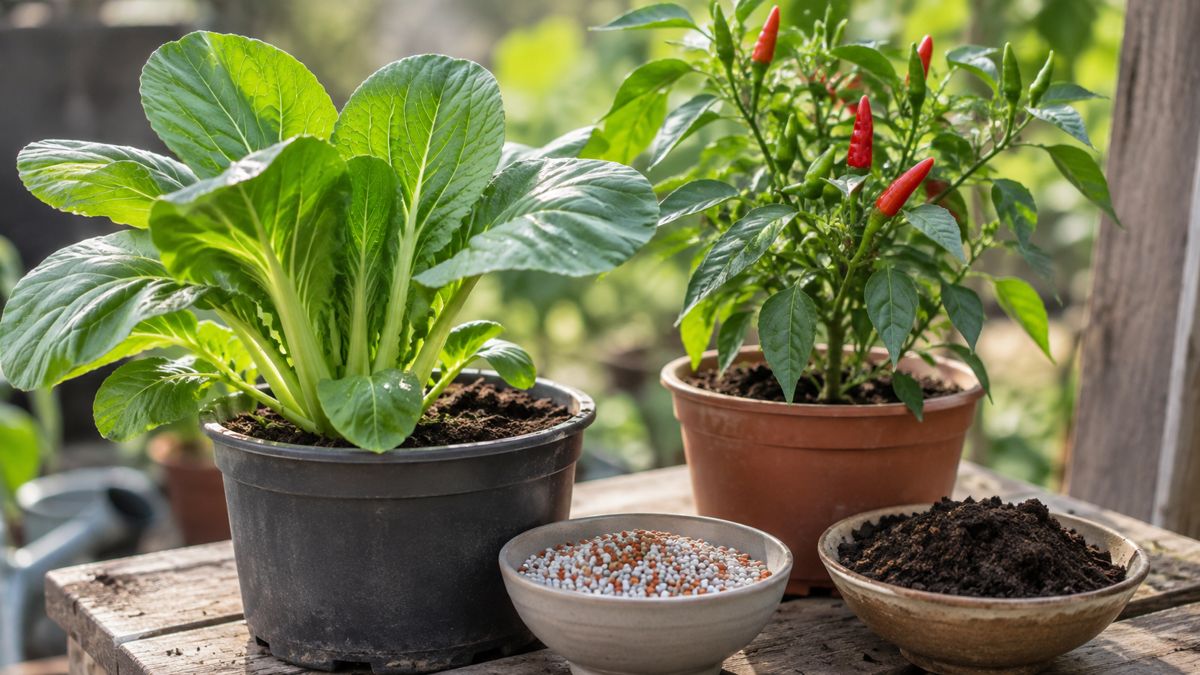
Start from the crop class, not the brand. Malaysia’s Department of Agriculture (DOA) schedules use two formulations consistently across vegetable classes:
| Vegetable class | Formulation | DOA dose example | Registry row era |
|---|---|---|---|
| Leafy (kailan, kangkung, bayam, sawi) | NPK 15:15:15 | 2 g/plant every 2 weeks (kailan, home container) [source]; bayam: chicken-manure basal 5 to 20 t/ha + NPK 15:15:15 0.6 to 1.0 by soil type [source] | pages 2023-2024, re-verified 2026-09/10 |
| Fruiting (brinjal, cucumber, long bean, chilli) | NPK 12:12:17:2 | brinjal 5 g/plant weekly [source]; cucumber 15 g/plant every 2 weeks [source]; long bean: chicken manure + 12:12:17:2 [source] | KENDIRI edition 2026; packages 1997-2024 |
| Basal (all classes) | Organic (rotted chicken manure / compost) | asam brinjal: compost 8-10 kg/bed before planting [source] | package 2013, fetched 2026-10-01 |
For the leafy class deep-dive in BM, our baja sayuran berdaun page carries the fuller schedule; for spend, the NPK price page carries dated rows.
Why do leafy and fruiting vegetables need different blends?
You sell the leaves of a leafy green — nitrogen drives leaf growth, so a balanced 15:15:15 at small frequent doses is enough. You sell the fruit of a fruiting vegetable — potassium and MgO drive fruit fill and quality, which is why 12:12:17:2 (17 K, 2 MgO) appears in every DOA schedule for brinjal, cucumber and long bean. Change the class, change the formulation — don’t just change the brand.
When do I fertilize — and when do I switch formulations?
The Sarawak asam brinjal technology package states the stage structure plainly: 15:15:15 during the vegetative stage, SWITCHING to 12:12:17:2+TE at flowering and fruiting, at 3-4 week intervals, with compost as the pre-plant basal. [source] That stage doctrine transfers to other fruiting vegetables: young and green — balanced; flowering — high potassium.
Is an organic base needed every season?
DOA’s bayam and long-bean schedules never drop the organic basal: chicken manure enters the table before the compound, by soil type (bayam: 5 to 20 tonnes per hectare). [source] The organic base builds structure and water-holding; the compound delivers nutrients on timing. In DOA doctrine they sit in the same table as complements — not as an either/or choice.
Is the “80% organic, 20% chemical” rule real?
No. The “80 organic : 20 chemical” ratio circulates in farmer groups and seller listings, but our research pass (DR relay t25, 2026-10-01) found zero primary DOA, MARDI or MyGAP documents carrying any such percentage — the phrasing traces back to distributor marketing scripts. [source] What is verifiable is the doctrine pair above (15:15:15 young / 12:12:17:2 flowering-fruiting) and the integrated-nutrient kg-increment guidance inside the technology packages. If a seller quotes a “ministry 80/20 rule” as the reason to buy, ask for the document — so far nobody has produced one.
What about AB mix and fertigation?
Soilless systems (fertigation, hydroponics) deliver nutrients as a dissolved solution: AB mix packs (A and B diluted separately) replace broadcast fertilizer, and the discipline shifts to EC and pH readings rather than grams per plant. Our BM hydroponic-vegetable fertilizer page owns that class. One safety rule stands: never mix concentrate A with concentrate B directly — they precipitate and spoil.
How much does a season of fertilizer cost?
Cost follows formulation, bag size and channel — the numbers move, so never borrow a stale price. The Malaysia NPK fertilizer price page stacks dated rows across 12-12-17, 15-15-15 and 16-16-16 repacks with RM-per-kg arithmetic; a gazetted April 2026 report put global fertilizer inflation above 120% since 2025 [source] — the reading date is half the value of the number. Run your own numbers in the fertilizer cost calculator before committing to bags.
How do I read the label before paying?
Three lines are non-negotiable: the N-P-K numbers (plus MgO/TE where present), the net pack weight, and the registration status. Labelled agricultural-product information has a statutory floor — set by Sabah’s fertilizer-label enactment [source] — an incomplete label is a red flag, not a bargain. Full walkthrough: reading NPK on a fertilizer label.
Where should I buy — an agro shop or online?
Both channels clear the same SKUs at different unit prices. Bulk 25-50 kg bags usually win at a physical agro dealer once freight is counted; small foliar packs favour online — but always recompute RM-per-kg of product before comparing, and ask for a photo of the actual batch label. The buy-online discipline and the 15:15:15 price rows are staged in our buying pages (same release intake).
Planning your program? Send your crop class, system and plot size through WhatsApp below — mention BETUL10 for 10% off your first GrowEasy order (GrowEasy specs and prices are attributed to the supplier; we are not the seller and guarantee no yields).
Where to buy: a physical agro shop nearby, or online?
The same fertilizer grade moves through two channels in Malaysia: the agro and farm-supply shops near you on one side, Shopee and Lazada storefronts on the other. Bulk bags usually work out cheaper at the physical agro shop, because freight pushes the online unit cost up; small foliar packs are usually easier to buy online. Both channels are legitimate — the difference is how you check and how you compute.
Before you pay on either channel, get these five things:
- A photo of the actual batch’s label — the container label of the batch that will actually reach you, not the catalogue image.
- The declared NPK, obtained by enquiry — not numbers read out of a listing title.
- Pack size and net weight in writing.
- A dated quote — fertilizer prices move; an old quote is not a comparison baseline.
- Registration or permit status, where the product class requires one.
The channel does not decide the grade: an online listing page is not a registration record, and a physical shop is not a guarantee of genuine stock. To compare across channels, use unit arithmetic — ringgit per kilogram for bagged and granular fertilizers, ringgit per litre for liquid foliar feeds — because face prices at different pack sizes do not compare directly.
NPK fertilizers can also be sourced through our supply channel on an enquiry basis — no published price, and we make no claim about its registration status [source]. Mention BETUL10 for 10% off your first order on WhatsApp; confirm the label, pack size, source and current price before you pay.
Baca juga: harga baja NPK Malaysia · cara baca NPK pada label baja · kalkulator kos baja tanaman
Good, best, veggie, fertiliser — one question, different spellings
Searchers write this question four ways — “best fertilizer for vegetables”, “good fertilizer for vegetables”, “best veggie fertilizer”, “best fertiliser for vegetables” — and all four land on the same answer: the crop-class rule on this page. Vegetable/veggie is the same noun; fertiliser is the British spelling of fertilizer; “good” and “best” are the same buying question at different confidence levels. We do not build separate pages for spelling variants, and we never add their search volumes together — each Planner row stands alone.
If you arrived here through any of those spellings: your next step is the same. Identify your crop class (leafy, fruiting, root), match the DOA schedule [source], and compare brands on RM-per-kg of product — the decision blocks above carry the verified doses.
Frequently asked questions
What is the best fertilizer for vegetables in Malaysia?
Follow the crop class. Leafy greens like kailan and kangkung get NPK 15:15:15 — the DOA home example is 2 g per plant every two weeks. Fruiting vegetables like brinjal and cucumber get NPK 12:12:17:2 — 5 g per plant weekly (brinjal) or 15 g every two weeks (cucumber). [source] [source] [source]
Is there an official 80% organic 20% chemical rule?
No. Our research pass (DR t25, 2026-10-01) found no primary DOA, MARDI or MyGAP document stating any 80/20 organic-to-chemical ratio; the phrasing traces to distributor marketing scripts. It circulates in grower groups as unattributed advice — do not base a fertilizer budget on it.
Why do fruiting vegetables need 12:12:17:2?
That formulation carries more potassium (K) and magnesium oxide (MgO) for fruit filling. The Sarawak asam brinjal technology package states the structure outright: 15:15:15 during the vegetative stage, switching to 12:12:17:2+TE at flowering and fruiting. [source]
Do I need organic fertilizer every season?
DOA schedules for bayam and long bean keep chicken manure as the basal dressing (bayam example: 5 to 20 tonnes/hectare by soil type) before the compound schedule. [source] Organic basal improves soil structure; it complements the compound schedule rather than replacing it.
How often should I fertilize leafy greens?
DOA's home container examples for kangkung and kailan: NPK 15:15:15 at 2 g per plant every two weeks after planting, watered twice daily. [source] [source]
How much will fertilizer cost for one season?
Cost moves with formulation, bag size and channel — see the NPK fertilizer price page for dated price rows and RM-per-kg arithmetic. Fertilizer prices rose more than 120% globally since 2025 per an April 2026 gazetted report, so the reading date is half the value of the number. [source]
How do I read an NPK label before buying?
Three lines matter: the N-P-K numbers (plus MgO/TE if present), the net pack weight, and the registration status. Labelled agricultural-product information has a legal floor — set by Sabah's fertilizer-label enactment [source] — an incomplete label is a warning sign, not a discount. Full guide: how to read NPK on a fertilizer label.
Where should I buy vegetable fertilizer in Malaysia?
Both channels sell the same SKUs at different unit prices. Bulk 25-50 kg bags usually win at physical agro shops once freight is counted; small foliar packs favour online — but always recompute RM-per-kg before comparing, and never infer grade from channel: an online listing is not a registration record.
What principle ties all these schedules together?
DOA's 4R: right source, right rate, right time, right place. More fertilizer does not mean more yield — the doses in DOA schedules are starting points, not floors to exceed. [source]