
Excavator Rental Price Malaysia: Plant Hire Rates, Tonnage Guide & Wet vs Dry Contract Checklist
Affiliate links: we may earn a commission. Disclosure
Decision details
Fits if: Ideal for smallholders, plantation managers, orchard owners, and civil engineering contractors needing temporary earthmoving capacity without capital machinery purchases.
Main drawback: Always verify minimum operating hour clauses, low-loader mobilisation fees, and site bridge/overhead power line clearances prior to equipment dispatch.
Compare: Machine operating tonnage (compact mini vs crawler), wet vs dry hire contract terms, and low-loader transit distance from depot.
In this guide
How does excavator rental pricing structure work in Malaysia?
Heavy equipment and plant hire providers in Malaysia structure excavator rental agreements based on operational scope, machinery class, and project location:
- Dry Hire Agreements: The machinery is rented without an operator or fuel. The hirer assumes full responsibility for supplying qualified machine operators, regular daily greasing, on-site fuel management, and daily maintenance checks. This setup is favored by established civil engineering contractors and plantation companies with existing in-house technical personnel.
- Wet Hire Agreements: The machinery is supplied complete with a skilled, certified operator and routine mechanical upkeep included. Fuel arrangements are either billed based on actual diesel consumption or supplied directly by the site owner. Wet hire is the preferred option for private landowners, smallholder farmers, and residential developers seeking immediate turnkey execution without labor management overhead.
- Transport Mobilisation and Demobilisation (Mob/Demob): Excavators cannot travel on public tarmac highways under their own power. Heavy low-loader trailer transport is billed as a separate flat round-trip charge to deliver the plant to the job site and retrieve it upon job completion.
- Security Deposits and Damage Bonds: Plant hire companies standardly collect a refundable security bond prior to dispatch to cover unexpected site damages, attachment wear, or contract extensions.
Comparing rental contract durations: Hourly, daily, weekly, and monthly rates
Choosing the appropriate rental time horizon is critical to avoid paying unnecessary machine idling penalties or multiple mobilisation charges:
| Rental Structure | Recommended Application | Key Operational Advantages | Commercial & Financial Considerations |
|---|---|---|---|
| Hourly Rental | Emergency drainage clearing, localized culvert repairs, half-day pipe trenching | Payment strictly corresponds to operating hours logged on the service meter | Subject to minimum operating hour commitments and fixed low-loader transport surcharges |
| Daily Rental | Short farm landscaping, house footing excavation, localized orchard terrace clearing | High flexibility to complete jobs within several days without extended capital lockup | Higher equivalent daily rate compared to long-term commitments; transport fee represents higher percentage of total cost |
| Weekly Rental | Intermediate agricultural road repairs, retention pond deepening, perimeter fencing ditching | Discounted weekly billing rates with dedicated equipment on standby on site | Requires on-site machinery security and scheduled weekend maintenance checks |
| Monthly Rental | Large plantation terracing, estate replanting, flood mitigation bunds, major civil development | Substantially lower daily cost equivalent and guaranteed machinery availability throughout weather windows | Hirer assumes site security, daily lubrication schedules, and safe overnight parking |
For smallholders and orchard managers, consolidating multiple earthmoving tasks (such as boundary ditching, farm track grading, and planting hole preparation) into a single continuous rental window eliminates redundant transportation expenses.
Machine tonnage selection: Compact mini excavators versus heavy crawler machines
Selecting the appropriate machine size balances hourly earthmoving productivity against site accessibility and transportation logistics:
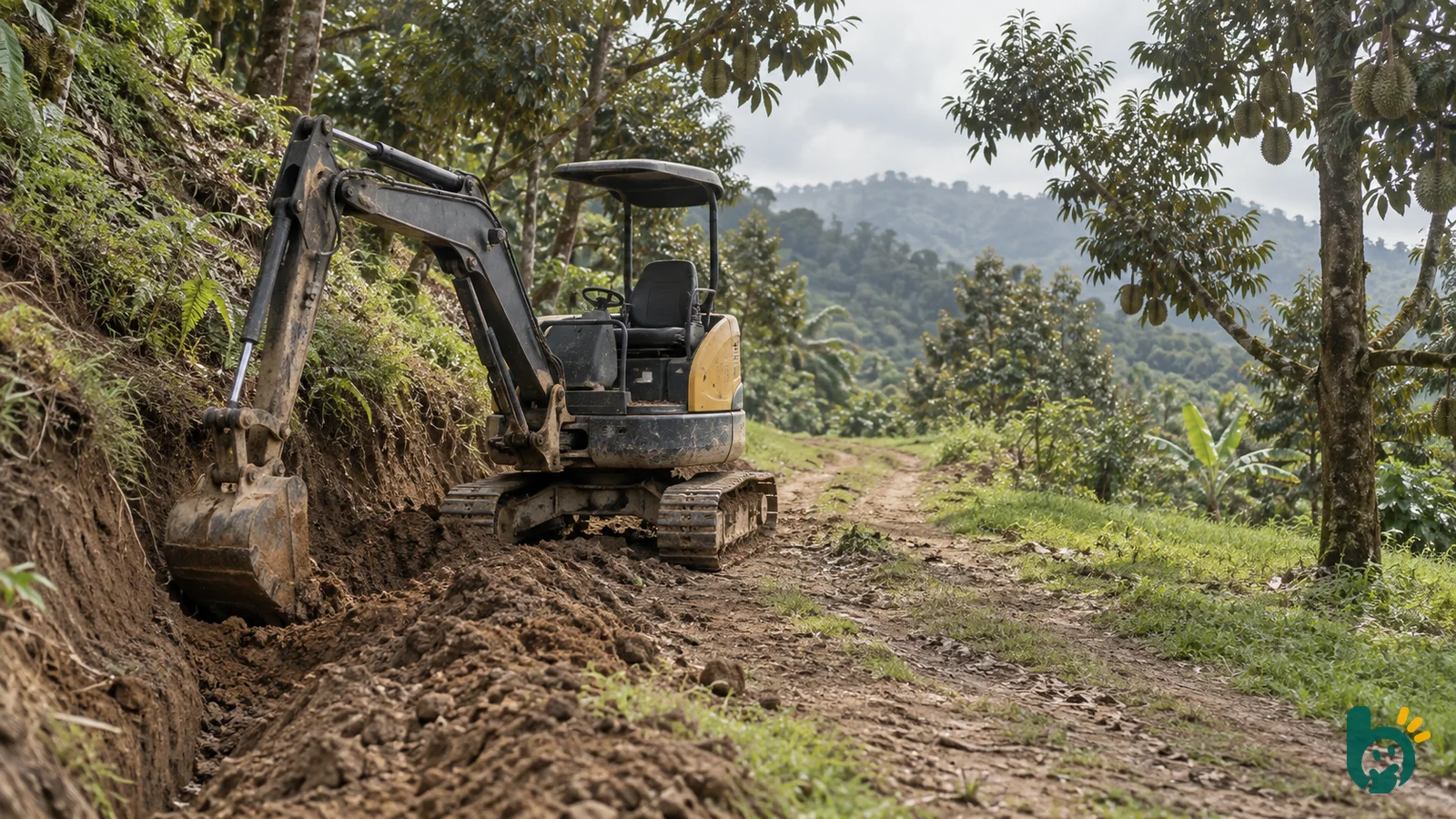
- Compact Mini Excavators (Micro to Small Tonnage): Featuring narrow track widths and zero-tail swing capability, mini excavators excel in confined spaces such as domestic backyards, inter-row orchard maintenance, greenhouse levelling, and narrow boundary trenching. These units can be hauled using standard flatbed recovery lorries, keeping mobilisation charges low and permitting access along narrow rural village roads.
- Medium-Class Excavators (Mid-Range Crawler Plant): Designed for serious agricultural earthworks, drainage canal widening, estate road terracing, and uprooting large tree stumps. These machines deliver heavy breakout force and deep digging reach, though they require heavy low-loader transport permits and stable road access.
- Heavy-Duty Crawler Excavators (Large Earthmovers): Deployed primarily for major quarrying, bulk overburden earthworks, hill cutting, and major civil infrastructure projects. Operating costs and fuel consumption are substantial, demanding full-time logistics coordination.
How do hydraulic breakers and specialized attachment add-ons affect hire rates?
Standard plant rental packages include a standard digging bucket with heavy-duty teeth. When ground conditions involve solid rock, concrete foundations, or hardpan clay, additional specialized attachments are required:
- Hydraulic Rock Breakers (Hammers): Used for crushing granite boulders, concrete footings, and limestone outcroppings. Because continuous hammering subjects the excavator arm and hydraulic pump to high hydraulic pressure spikes and mechanical vibrations, rental providers apply a specialized attachment surcharge.
- Augers and Post-Hole Borers: Ideal for rapid drilling of fence post holes, boundary piling, and deep seedling planting holes across agricultural estates.
- Hydraulic Tilting Buckets and Grading Blades: Essential for precision road grading, canal batter profiling, and surface slope finishing.
- Hydraulic Grapples and Clamshells: Deployed for selective timber clearing, boulder placement, and scrap handling.
When contracting an attachment package, always ensure that the hire company provides matching high-pressure hydraulic quick-coupler hoses and spare tool steel points.
Step-by-step checklist before hiring an excavator on site
Executing a smooth machine hire operation requires thorough pre-delivery preparation:
- Step 1: Inspect Site Ground and Soil Bearing Capacity: Ensure access tracks and bridge crossings can support the combined gross weight of the low-loader transporter and the excavator without sinking into soft peat or mud.
- Step 2: Clear Overhead Utilities and Tree Branches: Verify vertical clearance along site access paths, ensuring no low-hanging electrical cables, telecommunication wires, or thick overhanging tree boughs obstruct the transport truck.
- Step 3: Define Underground Pipeline and Cable Alignments: Mark out all buried water pipes, irrigation mains, electrical conduits, and septic drainage lines with high-visibility stakes before excavation begins.
- Step 4: Establish Fuel Storage and Security Protocols: For dry hire contracts, arrange clean on-site diesel storage drums, manual transfer pumps, and a secure, level parking pad to prevent fuel contamination and machinery tampering overnight.
- Step 5: Verify Operator Certifications and Insurance: Confirm that appointed operators hold valid competency cards and that adequate public liability insurance covers active site earthworks.
How do low-loader transport mobilisation logistics work across Malaysian states?
Mobilisation logistics represent a crucial variable in total plant hire expenses:
- Distance from Machine Depots: Transport fees scale with road travel distance between the machinery depot (typically located in major industrial clusters such as Shah Alam, Rawang, Johor Bahru, Kuantan, or Ipoh) and the rural project site.
- State Highway and Bridge Permits: Moving wide-tonnage machinery across federal trunk routes requires adherence to transport department safety guidelines, including escort vehicles and night transit windows for oversized loads.
- Island and Remote Estate Surcharges: Deploying machinery across island destinations or deep into remote logging and oil palm concessions involves specialized barge freight and unpaved logging road transport surcharges.
Are electric and battery-powered mini excavators suitable for agricultural work?
Electric and lithium-battery powered mini excavators are increasingly entering the Malaysian equipment landscape:
- Zero Direct Exhaust Emissions: Battery electric excavators eliminate diesel fumes completely, making them indispensable for indoor building basement excavation, confined warehouse works, and enclosed agricultural tunnels.
- Substantially Reduced Noise Profiles: Electric hydraulic drives operate with minimal noise output, allowing urban drainage and hospital perimeter trenching without violating strict residential noise regulations.
- Conventional Diesel Dominance in Agriculture: While battery machines excel in specialized urban niches, standard diesel-powered crawler excavators remain the backbone of rural agricultural development, forest clearing, and plantation land preparation due to rapid field refueling and lower base rental rates.
Baca juga: hub alat · mini-excavator-second-hand-en · harga-alat-berat-excavator-en
Frequently asked questions
What factors influence excavator rental rates in Malaysia?
Rates depend on machine tonnage, rental duration, transport mobilisation distance, diesel arrangements, and operator skill requirements.
Is it cheaper to rent an excavator by the month or by the day?
Monthly rentals offer significantly lower effective daily rates for ongoing land clearing or estate earthworks, while daily hires suit short ad-hoc jobs.
Are fuel and machine operators included in standard rental packages?
Standard contracts are structured either as dry hire without fuel and operator or wet hire including a certified operator and fuel.
What additional costs should be expected when renting heavy excavators?
Expect low-loader trailer transport mobilisation fees, attachment add-ons like hydraulic rock breakers, and refundable security deposits.